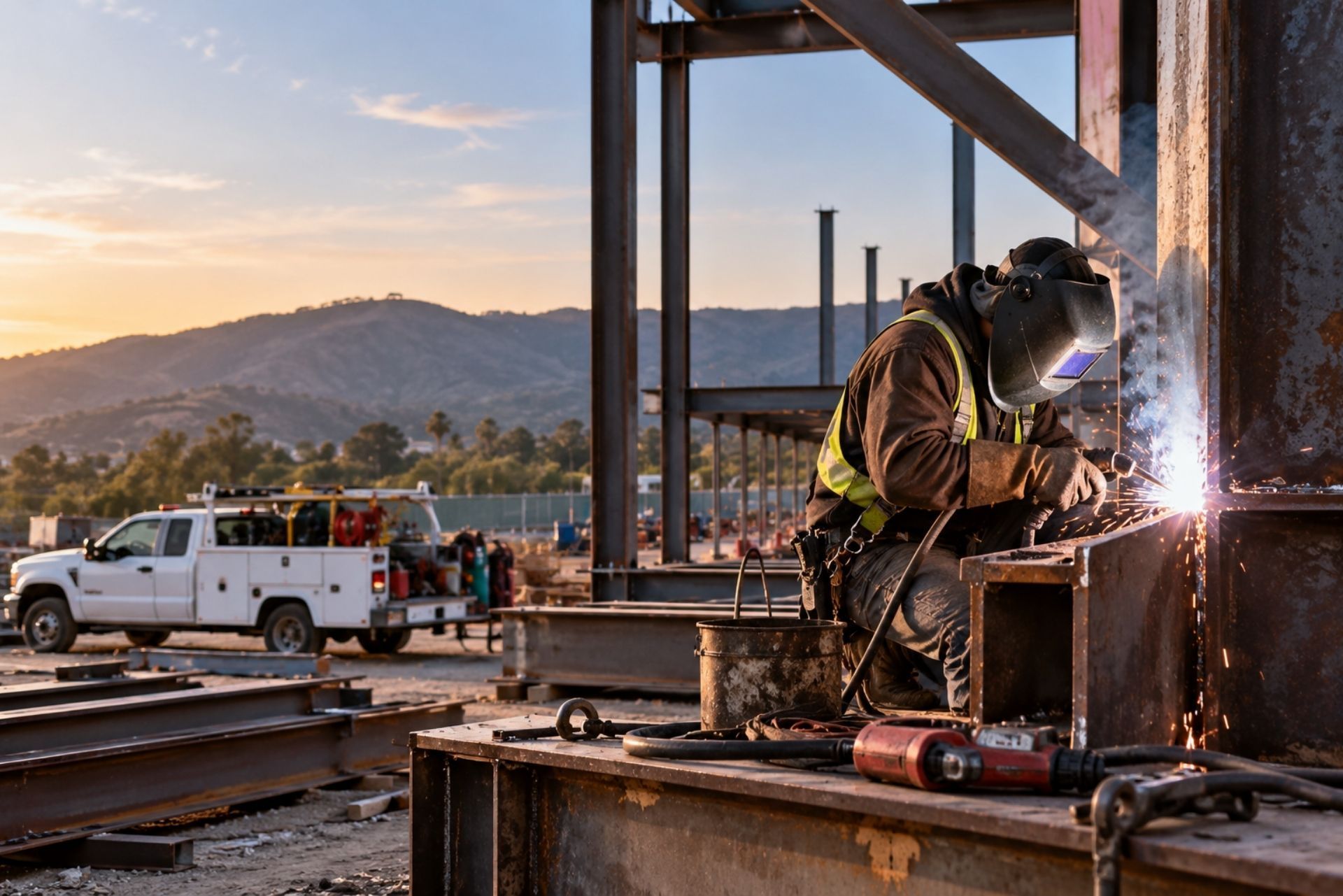
Most welding shops in California buy insurance the same way they buy consumables: they pick whatever the last supplier offered and hope it holds up. That works until a spark lands in a wall cavity on a Tuesday afternoon and a homeowner's attorney sends a letter three weeks later.
This guide breaks down
welding contractor insurance in California the way an
underwriter thinks about it: what gets claimed, what gets excluded, and what you'll actually pay. If you run a mobile rig, a
fabrication shop, or a structural crew, the gaps described here are the ones that sink businesses. Budget an hour to read this and compare it against your current declarations page. That hour could save you a six-figure uncovered loss.
California layers state rules, regional hazards, and a litigation-friendly climate on top of welding's built-in fire risk. Insurers price all three.
Start with licensing. The Contractors State License Board (CSLB) issues the C-60 Welding classification, and any licensed contractor with employees must have a workers' compensation certificate on file. If you have no employees, you need a formal exemption. CSLB also requires a contractor's bond, currently $25,000. A bond protects your customers, not you, so don't confuse it with insurance.
Geography matters more here than in most states. A welder working in the wildland-urban interface of Santa Clarita, Paradise, or the Santa Cruz Mountains during red flag conditions carries a very different exposure than one fabricating gates in a Fresno shop. Some carriers restrict or exclude field hot work during declared fire weather, and many local fire departments require hot work permits on commercial sites.
Then there's the contract side. General contractors in California routinely demand additional insured status, waivers of subrogation, and primary and noncontributory wording before you set foot on site. If your policy can't produce those endorsements, you lose bids. That makes your coverage a sales tool as much as a safety net.
By: Peter Plew
Commercial Insurance Agent at Caruso Insurance Services
Core Coverage: General Liability and Hot Work Risks
Commercial general liability (CGL) is the foundation. It pays for third-party bodily injury and property damage arising from your operations, plus your legal defense. Typical California welding contractors carry $1 million per occurrence and $2 million aggregate, and larger GCs increasingly ask for an umbrella pushing total limits to $5 million.
The catch is that a standard CGL form is just a starting point. Welding carriers frequently attach exclusions that quietly gut the policy. The ones worth hunting for on your forms:
- Hot work exclusions that remove coverage for fire caused by torches, arcs, or grinding
- Residential or tract housing exclusions that eliminate coverage for home projects
- Height limitations that void coverage above a set number of stories
- Action-over exclusions that block claims when your employee sues the GC, who then tenders to you
Fire Damage and Open Flame Endorsements
The standard "damage to premises rented to you" sublimit, often $100,000, only covers fire damage to space you rent. It does nothing for a customer's warehouse. What you need is confirmation that hot work is fully covered under your main occurrence limit, with no fire sublimit.
Picture a mobile welder repairing a steel stair rail at a Sacramento restaurant. Slag drops behind a kitchen hood, smolders, and ignites after closing. The repair cost: roughly $380,000 in building damage plus $90,000 in lost business income. With a $50,000 hot work sublimit, the welder personally owes $420,000. Paying an extra $1,200 a year to remove that sublimit breaks even the first time a claim exceeds $50,000, which most fire claims do.
Carriers reward documented controls. Keep written hot work permits, assign a fire watch that stays at least 30 minutes after work ends (the NFPA 51B standard), and photograph the work area before and after. That paperwork wins claims and lowers renewal pricing.
Completed Operations and Structural Integrity Claims
Completed operations coverage responds after you've left the job. A cracked weld on a balcony support, a failed moment connection, or a trailer hitch that separates on the 5 Freeway can surface years later.
California's statute of repose allows construction defect claims up to 10 years after substantial completion for latent defects. That's why GCs ask you to keep completed operations coverage, and additional insured status, active for years after the job. If you switch carriers or close your business, ask about tail options. Letting a policy lapse can leave a decade of past work uninsured.
California Workers' Compensation for Welding Crews
Workers' comp is mandatory in California the moment you hire one employee, including part-time help. Operating without it is a crime, and the state can issue stop-orders that shut down your jobs immediately, plus heavy penalties. CSLB can also suspend your license.
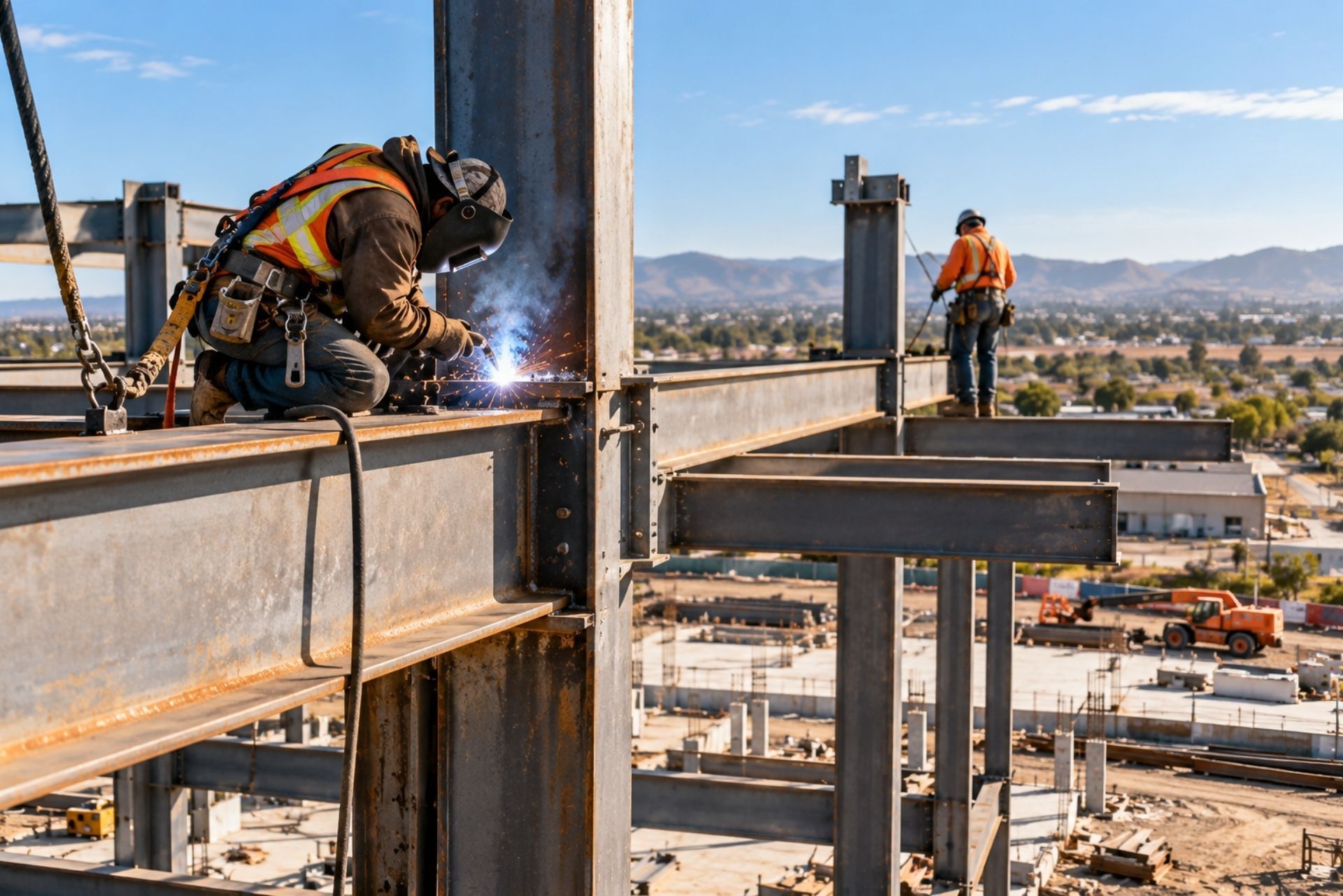
Welding generates some of the costliest claims in construction. Common ones include:
- Burns and eye injuries from arc flash and spatter
- Falls during structural and elevated work
- Respiratory illness from fumes, especially on stainless steel and galvanized metal, where hexavalent chromium and zinc oxide are concerns
- Cumulative trauma, a major claim category in California, involving shoulders, backs, and hearing loss
California rates are set through classifications maintained by the Workers' Compensation Insurance Rating Bureau (WCIRB), and welding often lands in expensive classes, particularly when combined with ironwork or erection. Premium is calculated per $100 of payroll, so classifying payroll correctly matters. A shop worker doing fabrication shouldn't be billed at a field erection rate. Split payroll accurately and keep timesheets that support it at audit.
Your experience modification rate (X-Mod) is the multiplier that follows you. One serious burn claim can push an X-Mod from 0.90 to 1.25 for three years. On $400,000 of payroll at a $10 rate, that's the difference between $36,000 and $50,000 a year, or $42,000 in extra premium across the rating window. Return-to-work programs and fume extraction systems pay for themselves fast.
Specialized Add-ons for the Welding Trade
Liability and workers' comp keep you legal. These coverages keep you operating after a theft, a design dispute, or a damaged rig.
Inland Marine: Protecting Mobile Rig Gear
A loaded welding truck can carry $40,000 to $100,000 in machines, plasma cutters, bottles, and leads. Your commercial auto policy covers the truck, not most of the permanently attached or loose equipment. Inland marine, often written as a contractor's equipment floater, covers tools on the road, on jobsites, and in storage.
Choose replacement cost over actual cash value if you can afford it. A five-year-old engine-drive welder may carry an actual cash value of $3,500, while replacing it costs $8,000. Also check theft terms: some policies require visible signs of forced entry or exclude unattended vehicles overnight. Keep a serial-numbered inventory with photos and update it every January.
Professional Liability for Design-Build Projects
If you stamp, draw, or specify anything, such as custom staircases, structural connections, or ornamental railings designed in-house, you have professional exposure. CGL typically excludes errors in design, engineering advice, and specifications.
Suppose you design a cantilevered steel awning for a Long Beach retailer, it deflects beyond tolerance, and the owner demands $65,000 for redesign and refabrication. With no physical injury or property damage, your CGL likely pays nothing. A contractor's professional liability policy around $1 million often runs a few thousand dollars a year for smaller firms. One avoided claim covers decades of premium.
Pricing varies widely, so treat any number as a range rather than a quote. A solo mobile welder doing light repair might see general liability in the low thousands annually, while a structural crew with $1 million in payroll can spend six figures across all lines. The factors that move your costs most:
| Factor | Why It Matters |
|---|---|
| Field vs. shop work | Field hot work near combustibles costs more than controlled shop fabrication |
| Project type | Residential, high-rise, and wildfire-zone work raise rates |
| Payroll and revenue | Primary rating basis for comp and GL |
| Claims history | Insurers request 3 to 5 years of loss runs |
| Safety documentation | Hot work permits and training records earn credits |
| Deductible choice | Higher deductibles cut premium |
Your loss runs work like a commercial version of the CLUE database that homeowners insurers use: every claim, even a small one paid as a courtesy, follows you to the next carrier. Consider paying a $2,500 property damage claim out of pocket. If filing it raises your GL premium $1,500 a year for three years, you've lost $2,000.
Deductibles deserve the same math. Moving from a $1,000 to a $5,000 GL deductible might save $900 a year. If you file one claim every five years, you save $4,500 and absorb $4,000 more in deductibles: a modest win, but only if you have $5,000 in cash ready. If you don't, keep the lower deductible.
Selecting the Right Policy for Long-Term Compliance
The best welding contractor policy in California isn't the cheapest quote. It's the one that has no hot work sublimit, no residential exclusion you'd trip over, completed operations that survive a carrier switch, and endorsements your GCs will accept without a fight.
Before your next renewal, work through this checklist:
- Request full policy forms, not just the quote summary, and read every exclusion
- Confirm hot work is covered at full limits in writing
- Verify additional insured, waiver of subrogation, and primary/noncontributory endorsements are available on a blanket basis
- Audit workers' comp payroll classifications against actual duties
- Update your equipment schedule with serial numbers and replacement values
- Pull your loss runs and correct any errors before shopping
Work with a broker who places welding and metal trades regularly, since generalists often miss trade-specific exclusions. Review coverage every year, and immediately after you add structural work, design services, or projects in fire-prone counties.
California rewards welders who document their work and punishes those who assume. Pull out your declarations page this week, compare it against this guide, and fix the gaps while they're still cheap to fix. The spark you prepare for is far less costly than the one you don't.
ABOUT THE AUTHOR:
PETER PLEW
Hi my name is Peter Plew and I am a commercial insurance professional. I listen to and strategize with business owners about their visions of the future and assist in getting there as quickly as possible. I help identify unique exposure and risk’s that business owners have and the reasons why they need to be insured against them. My goal is to make sure my clients are always taken care of on a daily basis with any service needs, questions, or concerns they may have. I love to golf and spend time with my family in my spare time.
Contact Us

Service that stays with you.
Our team helps simplify insurance decisions for families and businesses. We focus on clear explanations, fast responses, and dependable service. You can count on us for help with coverage questions, updates, and long-term support.
Coverage that keeps you secure
Reliable Protection for Everyday Life
Home insurance helps protect your house, personal belongings, and liability risks. We explain coverage options clearly so you know what your policy includes.
Auto insurance provides protection for accidents, liability, and vehicle damage. We help you compare options so you can choose coverage that fits your driving needs.
Motorcycle insurance provides coverage for riders and their bikes. We help you select options that match how and where you ride.
RV insurance supports protection for motorhomes and recreational vehicles. Coverage applies during travel and while parked.
Coverage Built for Contractors and Trades
Support that keeps your work moving.

General Liability Insurance
General liability insurance helps protect contractors from injury and property damage claims. It supports jobsite requirements and contracts.

Workers Compensation
Workers compensation insurance helps protect employees injured while working. It also supports compliance with state requirements.
Commercial Auto Insurance
Commercial auto insurance provides coverage for work vehicles used on jobsites. It helps protect drivers and company vehicles.
Contractor Insurance
Contractor insurance supports trades and service professionals across Southern California. It helps protect tools, equipment, and daily operations.

Cyber Liability Insurance
Cyber liability insurance helps protect business data and customer information. It supports recovery from digital incidents.

Commercial Property Insurance
Commercial property insurance helps protect offices, shops, and equipment. It supports recovery after covered damage.
Coverage Built for Specialized Work
Support for high-risk and service-driven industries.
Simple Steps Supported by Steady Guidance
A Clear Path to Coverage
Trusted by Clients Across Southern California
Clear service backed by real experiences.
Answers to Common Questions.
Clear explanations to guide your decisions.
How do I know which insurance policy is right for me?
We compare coverage options from multiple carriers to help you see differences in protection and price. You can review clear details and ask questions so you understand what each policy covers. Our team guides you step by step so you feel sure about your decision.
What factors affect my auto insurance premium?
Auto insurance premiums are influenced by your driving history, age, location, vehicle type, and coverage choices. A clean driving record and good safety features can help lower costs. We review these factors with you and help find coverage that fits your budget and needs.
Does homeowners insurance cover all types of damage?
Standard homeowners insurance protects your structure, personal belongings, liability, and additional living expenses in many cases. However, it usually does not include flood or earthquake damage without separate policies. We help you decide if extra coverage is right for your home and location.
Can I update my policy or get certificates online?
Yes. You can submit requests for policy changes and certificates through our online service form at any time. Our team processes those requests quickly and confirms updates once complete so you have the documents you need.
Do I need separate insurance for business risks like EPLI or E&O?
Yes. General liability and workers compensation cover many business risks but do not protect against all exposures. For example, Employment Practices Liability Insurance (EPLI) covers claims like wrongful termination or discrimination, and Errors & Omissions (E&O) covers claims based on mistakes in professional services. We help you identify which extra policies your business may need.
What happens if I need to file a claim?
If you need to file a claim, we guide you through the process and help you contact the insurance carrier. We explain what information you should provide, answer your questions, and stay available while the carrier reviews your claim. This support helps you move forward with confidence.
Contact Us