A single misfire during a sprinkler system install can flood a commercial building, destroy inventory, and trigger a liability claim that reaches seven figures before the week is out. Fire-protection contractors in California face a uniquely intense combination of regulatory scrutiny, physical hazard, and financial exposure. The work itself is inherently dangerous: pressurized systems, torch soldering near combustible materials, confined-space entries, and installations that must perform flawlessly when an actual fire breaks out years later. If the system fails, the contractor who installed it is the first name on the lawsuit.
Getting the right insurance coverage isn't just about checking a compliance box for your license. It's about building a financial safety net that matches the real-world risks of your trade. California fire-protection contractors need a specific combination of policies: general liability, completed operations, tools and equipment coverage, commercial auto, workers' compensation, and a reliable system for managing certificates of insurance. Each piece solves a different problem, and gaps between them are where contractors lose their businesses.
This guide breaks down what each coverage does, what California requires, and where contractors most commonly get burned.
Risk Landscape for California Fire-Protection Contractors
Fire-protection work sits at the intersection of construction, mechanical contracting, and life-safety engineering. That combination creates a risk profile unlike almost any other trade. A plumber's mistake might cause water damage. A fire-protection contractor's mistake can result in deaths during a building fire, followed by wrongful death litigation that names every entity in the installation chain.
California's regulatory environment adds another layer. The state's contractor licensing board, building codes, and labor laws are among the strictest in the country. Operating without proper insurance doesn't just expose you to financial ruin: it can cost you your license and result in criminal penalties.
CSLB Licensing and Insurance Requirements
The Contractors State License Board (CSLB) requires all licensed contractors to carry a minimum surety bond of $25,000 as of 2026. Fire-protection contractors typically hold a C-16 (Fire Protection) license, and the CSLB mandates that any employer with even one employee carry workers' compensation insurance. There's no exception for small shops or family businesses.
The CSLB actively investigates complaints and can suspend or revoke licenses for lapses in required coverage. If your workers' comp policy cancels and you don't replace it within the grace period, your license status changes to "inactive" in the CSLB database, which general contractors and property owners check before awarding bids. A lapse that lasts even a few weeks can cost you months of work.
High-Stakes Exposure in Fire Suppression and Sprinkler Installation
The exposure profile for C-16 contractors goes well beyond typical construction risk. Sprinkler systems involve water under pressure, chemical suppression agents, and electrical connections to alarm panels. A wet system that freezes and bursts in a cold-storage facility can cause hundreds of thousands in product loss. A dry chemical system that discharges accidentally can contaminate a clean room or data center.
Then there's the long-tail risk: a system installed in 2026 that fails during a fire in 2034. California's statute of repose for construction defects is ten years, meaning you can be sued for a faulty installation nearly a decade after you finished the job. That's why completed operations coverage isn't optional: it's the policy that protects you after you leave the site.

By: Larry Scott
Personal Insurance Agent at Caruso Insurance Services
Core General Liability and Completed Operations Coverage
General liability is the foundation of any fire-protection contractor's insurance program. It covers third-party claims for bodily injury and property damage arising from your operations. But the standard policy has two distinct parts that contractors need to understand separately, because they protect against very different scenarios.
Protecting Against Third-Party Bodily Injury and Property Damage
Your commercial general liability (CGL) policy responds when someone who isn't your employee gets hurt or their property is damaged because of your work. A pipe fitter drops a section of steel from a ladder and it strikes a building tenant. A soldering torch ignites insulation in an adjacent wall cavity. A test of a suppression system sends foam into an occupied office suite.
Most general contractors require their fire-protection subs to carry at least $1 million per occurrence and $2 million aggregate in general liability. Many larger projects, particularly hospitals, high-rises, and government buildings, require $5 million or more, often achieved through an umbrella or excess policy layered on top of the primary CGL.
The Critical Role of Products and Completed Operations Coverage
This is the coverage that keeps you protected after you hand over the keys. Products and completed operations coverage, included within the CGL but tracked under its own aggregate limit, responds to claims arising from work you've already finished or products you've installed. If a sprinkler head you installed three years ago fails to activate during a fire, this is the coverage that pays for the defense and any resulting judgment.
California courts have consistently held fire-protection contractors liable for system failures years after installation. Carrying a separate completed operations aggregate of at least $2 million is standard practice, and many contractors carry higher limits given the catastrophic nature of potential claims. Make sure your policy doesn't sunset this coverage: some cheaper policies exclude completed operations after a set period.
Professional Liability vs. General Liability for System Design
Here's a distinction that trips up many contractors: if you design fire-protection systems, not just install them, your general liability policy probably won't cover design errors. CGL policies typically exclude professional services. A miscalculated hydraulic design that results in inadequate water pressure during a fire is a professional liability claim, not a general liability claim.
If your C-16 work includes system design, fire engineering calculations, or plan review, you need a separate professional liability (errors and omissions) policy. These policies are claims-made rather than occurrence-based, which means you need to maintain continuous coverage even after you stop performing design work, through what's called a "tail" endorsement.
Protecting Physical Assets: Tools, Equipment, and Inland Marine
Fire-protection contractors rely on specialized, expensive equipment that moves between job sites constantly. Standard commercial property policies are designed for assets that stay in one location. That's where inland marine coverage comes in: it's specifically built for property in transit or at temporary locations.
Coverage for Mobile Equipment and Specialized Fire-Testing Tools
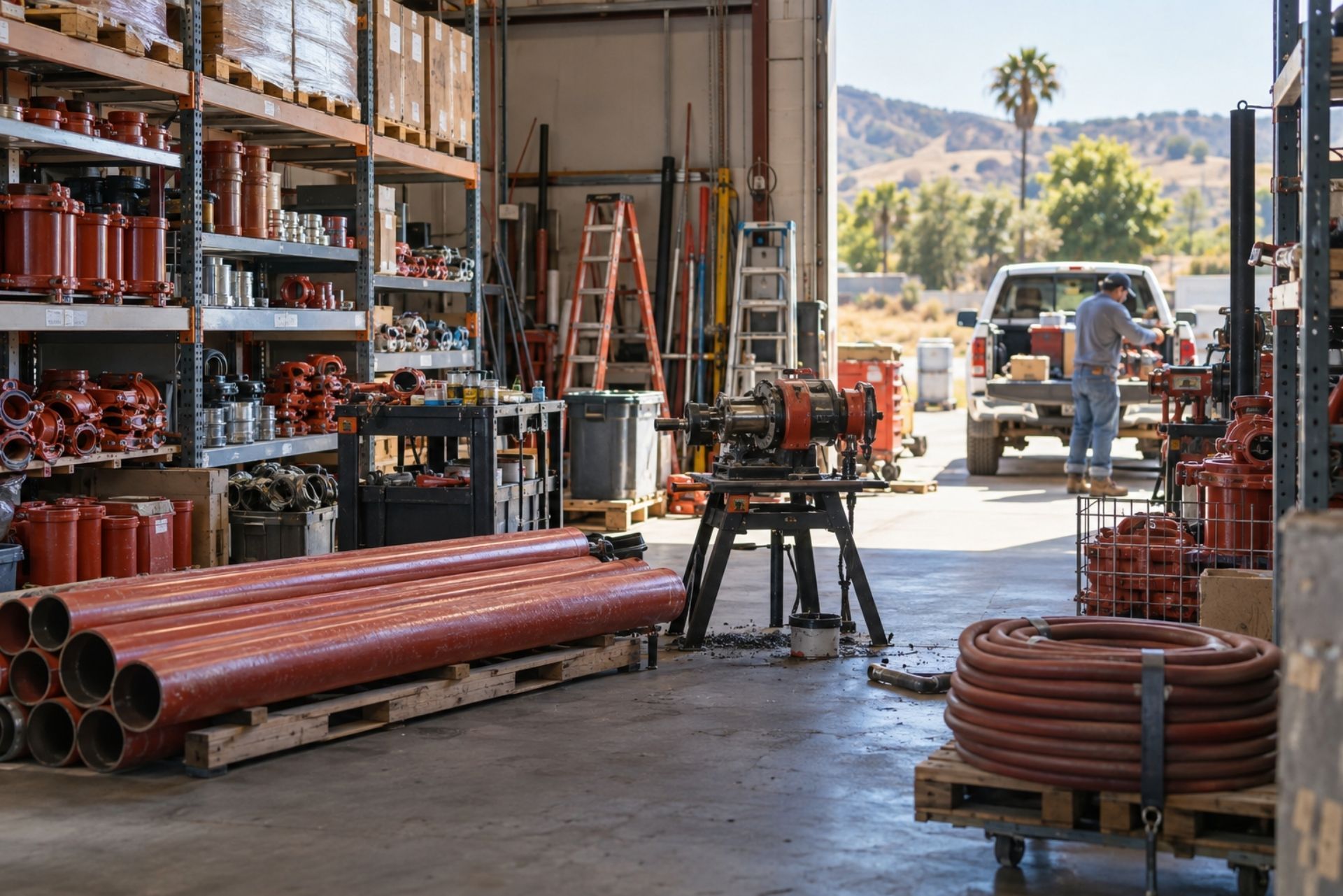
Hydraulic testing pumps, pipe threading machines, groove-cutting tools, backflow test kits, and inspection cameras can easily represent $50,000 to $200,000 in mobile assets for a mid-size fire-protection shop. An inland marine policy (sometimes called a contractor's equipment floater) covers these items wherever they travel: on the truck, at a job site, or in a temporary storage container.
Make sure your policy covers replacement cost rather than actual cash value. A five-year-old pipe threader might depreciate to $3,000 on paper, but replacing it costs $12,000. The premium difference between ACV and replacement cost coverage is usually small relative to the protection it provides.
Theft and Vandalism Protection on Job Sites
Job-site theft is a persistent problem in California construction. Copper pipe, brass fittings, and power tools disappear from sites regularly, particularly on projects where the building isn't yet secured. Your inland marine policy should cover theft without requiring evidence of forced entry, since many job sites don't have lockable enclosures during early construction phases.
Document your equipment with serial numbers, photographs, and purchase receipts. Insurers process theft claims much faster when you can provide a detailed inventory. Some carriers offer premium credits for contractors who use GPS tracking on high-value equipment or store tools in locked gang boxes with tamper-resistant hardware.
Commercial Auto Insurance for Fleet Safety
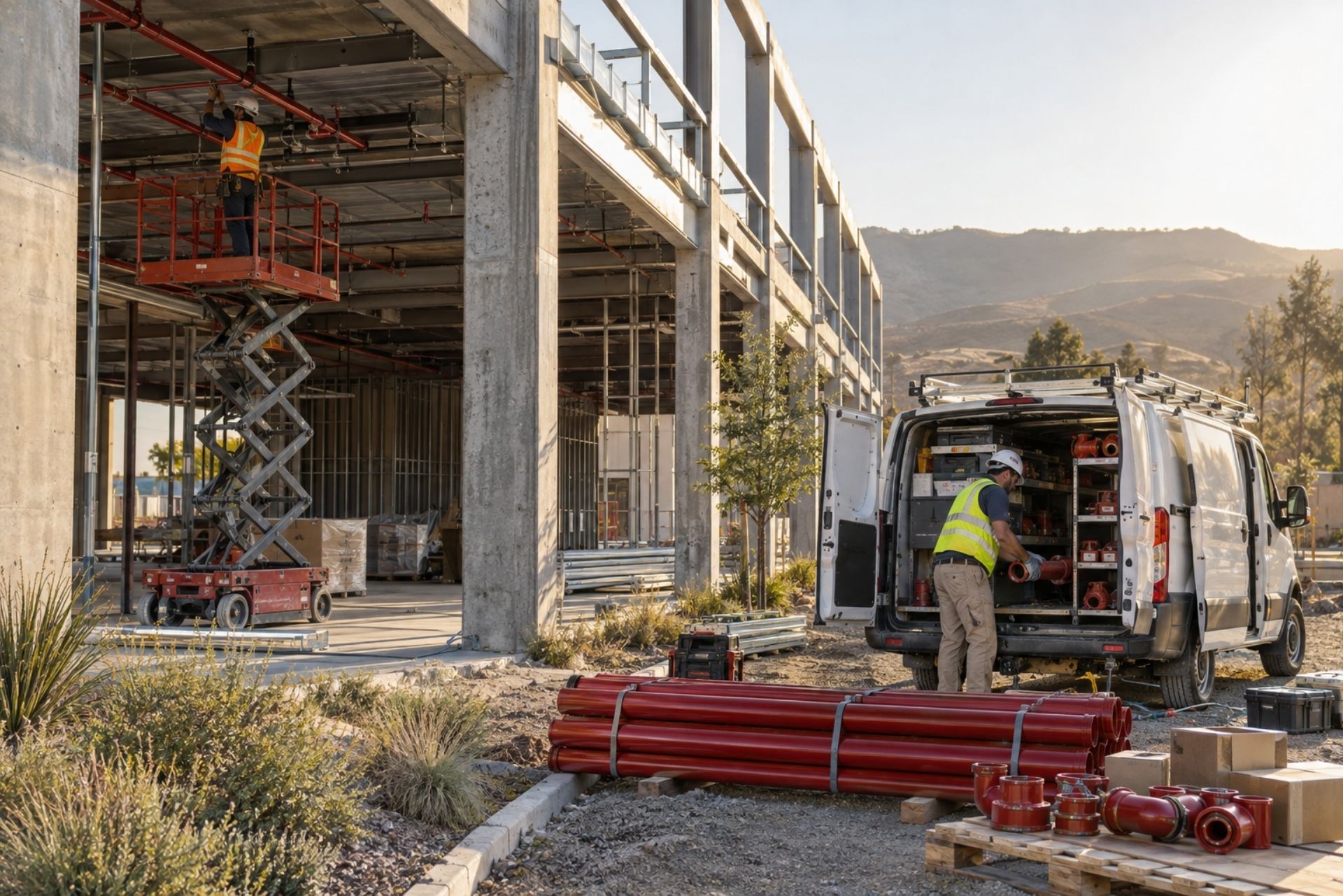
Most fire-protection contractors operate fleets of service vans, pipe trucks, and occasionally boom trucks or trailers. These vehicles are on California roads daily, often loaded with heavy materials, and commercial auto insurance is both a legal requirement and a significant area of exposure.
Hired and Non-Owned Auto Liability for Contractors
Your commercial auto policy covers vehicles your company owns. But what about the employee who runs to the supply house in their personal car? Or the rental truck you grab for a big delivery? Hired and non-owned auto (HNOA) coverage fills these gaps. Without it, an accident involving a personal vehicle on company business creates a liability hole that your business auto policy won't touch.
HNOA coverage is inexpensive relative to its value, typically adding a few hundred dollars annually to your commercial auto premium. If any employee ever uses a personal vehicle for work purposes, even occasionally, this endorsement is essential.
California Minimums vs. Recommended Liability Limits
California's minimum auto liability limits are $15,000/$30,000 for bodily injury and $5,000 for property damage. Those numbers are laughably inadequate for a commercial vehicle. A loaded pipe truck that rear-ends a passenger car can easily generate claims exceeding $500,000.
Most fire-protection contractors should carry at least $1 million in combined single-limit auto liability. If you operate heavier vehicles or work in congested urban areas like Los Angeles or the Bay Area, consider $2 million or higher through an umbrella policy that extends over your auto coverage. The cost difference between $500,000 and $1 million in auto liability is typically modest: often less than $500 per year for a small fleet.
Workers' Compensation and Labor Law Compliance
Workers' compensation is non-negotiable in California. Every employer must carry it, and fire-protection work carries classification codes with some of the highest premium rates in the construction industry due to the physical hazards involved.
Statutory Requirements for California Employers
California requires workers' comp coverage from the moment you hire your first employee. There is no minimum employee count threshold and no exemption for part-time workers. Sole proprietors and partners can elect to exclude themselves from coverage, but doing so means any injury they sustain on the job has no insurance backstop.
Operating without workers' comp in California is a criminal offense, punishable by fines up to $100,000 and up to one year in county jail. The CSLB can also issue a stop-work order and revoke your contractor's license. The state's Uninsured Employers Benefits Trust Fund will pay injured workers' claims and then pursue the employer for reimbursement, plus penalties.
Managing Experience Modification Ratings (Ex-Mod) in High-Risk Trades
Your experience modification rate, or Ex-Mod, is a multiplier applied to your workers' comp premium based on your claims history compared to other businesses in your classification. A rating of 1.0 means your claims experience is average. Below 1.0 means you're better than average and you pay less. Above 1.0 means you pay more.
For fire-protection contractors, a single serious injury can push your Ex-Mod above 1.0 for three years, adding tens of thousands in annual premium. A back injury that generates $80,000 in medical costs might increase your annual premium by $15,000 to $25,000 for each of those three years. Investing in safety training, proper PPE, and return-to-work programs isn't just good practice: it directly affects your bottom line through lower Ex-Mod ratings.
Streamlining Certificates of Insurance and Compliance
Certificates of insurance are the paperwork that proves you carry the coverage you claim. For fire-protection contractors working as subcontractors on larger projects, managing COIs is a constant administrative task that directly affects your ability to win and keep work.
Understanding Additional Insured Endorsements
General contractors and property owners almost always require that they be added as additional insureds on your general liability policy. This endorsement gives them coverage under your policy for claims arising from your work. It's standard practice, and most commercial insurers include blanket additional insured endorsements in their contractor policies.
Pay attention to the specific endorsement form used. The CG 20 10 (for ongoing operations) and CG 20 37 (for completed operations) are the most commonly requested. Some GCs require primary and noncontributory status, meaning your policy pays first regardless of any coverage the GC carries. Make sure your policy includes this language, or you'll get kicked off bid lists.
Managing COIs for Subcontractors and General Contractors
If you hire subcontractors for portions of your fire-protection work, you need to collect and verify their certificates before they set foot on a job site. A sub without proper coverage creates a liability gap that flows uphill to you. California courts have consistently held hiring contractors responsible for injuries to uninsured subcontractor employees.
Use a certificate tracking system, whether that's dedicated software like myCOI or a well-maintained spreadsheet, to monitor expiration dates and coverage limits. Set reminders 30 days before each policy renewal date. Many contractors have lost projects because a subcontractor's coverage lapsed and nobody caught it until the GC ran an audit.
Building a Complete Insurance Program
Fire-protection contractor insurance in California isn't a single policy: it's a coordinated set of coverages that must work together without gaps. General liability protects your operations. Completed operations protects your finished work for years. Inland marine covers your tools and equipment. Commercial auto covers your fleet. Workers' comp keeps you legal and protects your crew. And a solid COI management process keeps you eligible for the projects that grow your business.
The contractors who get this right don't just avoid catastrophe: they win better projects, negotiate from a position of strength, and sleep better knowing a single bad day won't end everything they've built. Work with a broker who specializes in construction and understands the specific exposures of fire-protection work. Generic business insurance agents often miss critical endorsements or underestimate the limits you actually need. Your insurance program should be as carefully engineered as the suppression systems you install.
ABOUT THE AUTHOR:
LARRY SCOTT
Hello! My name is Larry Scott. I have been in the insurance industry for 21+ years, with a background in Personal, Commercial, and Bonding. I support Caruso Insurance’s goal of providing convenient and competitive insurance coverage for our clients by focusing on each client’s individual needs. I am dedicated to continuing education and staying up to date with technology in the forever changing insurance world. I am a family man and enjoy any time I get to spend with my kids. I love cooking and drinking wine.
Contact Us

Service that stays with you.
Our team helps simplify insurance decisions for families and businesses. We focus on clear explanations, fast responses, and dependable service. You can count on us for help with coverage questions, updates, and long-term support.
Coverage that keeps you secure
Reliable Protection for Everyday Life
Home insurance helps protect your house, personal belongings, and liability risks. We explain coverage options clearly so you know what your policy includes.
Auto insurance provides protection for accidents, liability, and vehicle damage. We help you compare options so you can choose coverage that fits your driving needs.
Motorcycle insurance provides coverage for riders and their bikes. We help you select options that match how and where you ride.
RV insurance supports protection for motorhomes and recreational vehicles. Coverage applies during travel and while parked.
Coverage Built for Contractors and Trades
Support that keeps your work moving.

General Liability Insurance
General liability insurance helps protect contractors from injury and property damage claims. It supports jobsite requirements and contracts.

Workers Compensation
Workers compensation insurance helps protect employees injured while working. It also supports compliance with state requirements.
Commercial Auto Insurance
Commercial auto insurance provides coverage for work vehicles used on jobsites. It helps protect drivers and company vehicles.
Contractor Insurance
Contractor insurance supports trades and service professionals across Southern California. It helps protect tools, equipment, and daily operations.

Cyber Liability Insurance
Cyber liability insurance helps protect business data and customer information. It supports recovery from digital incidents.

Commercial Property Insurance
Commercial property insurance helps protect offices, shops, and equipment. It supports recovery after covered damage.
Coverage Built for Specialized Work
Support for high-risk and service-driven industries.
Simple Steps Supported by Steady Guidance
A Clear Path to Coverage
Trusted by Clients Across Southern California
Clear service backed by real experiences.
Answers to Common Questions.
Clear explanations to guide your decisions.
How do I know which insurance policy is right for me?
We compare coverage options from multiple carriers to help you see differences in protection and price. You can review clear details and ask questions so you understand what each policy covers. Our team guides you step by step so you feel sure about your decision.
What factors affect my auto insurance premium?
Auto insurance premiums are influenced by your driving history, age, location, vehicle type, and coverage choices. A clean driving record and good safety features can help lower costs. We review these factors with you and help find coverage that fits your budget and needs.
Does homeowners insurance cover all types of damage?
Standard homeowners insurance protects your structure, personal belongings, liability, and additional living expenses in many cases. However, it usually does not include flood or earthquake damage without separate policies. We help you decide if extra coverage is right for your home and location.
Can I update my policy or get certificates online?
Yes. You can submit requests for policy changes and certificates through our online service form at any time. Our team processes those requests quickly and confirms updates once complete so you have the documents you need.
Do I need separate insurance for business risks like EPLI or E&O?
Yes. General liability and workers compensation cover many business risks but do not protect against all exposures. For example, Employment Practices Liability Insurance (EPLI) covers claims like wrongful termination or discrimination, and Errors & Omissions (E&O) covers claims based on mistakes in professional services. We help you identify which extra policies your business may need.
What happens if I need to file a claim?
If you need to file a claim, we guide you through the process and help you contact the insurance carrier. We explain what information you should provide, answer your questions, and stay available while the carrier reviews your claim. This support helps you move forward with confidence.
Contact Us