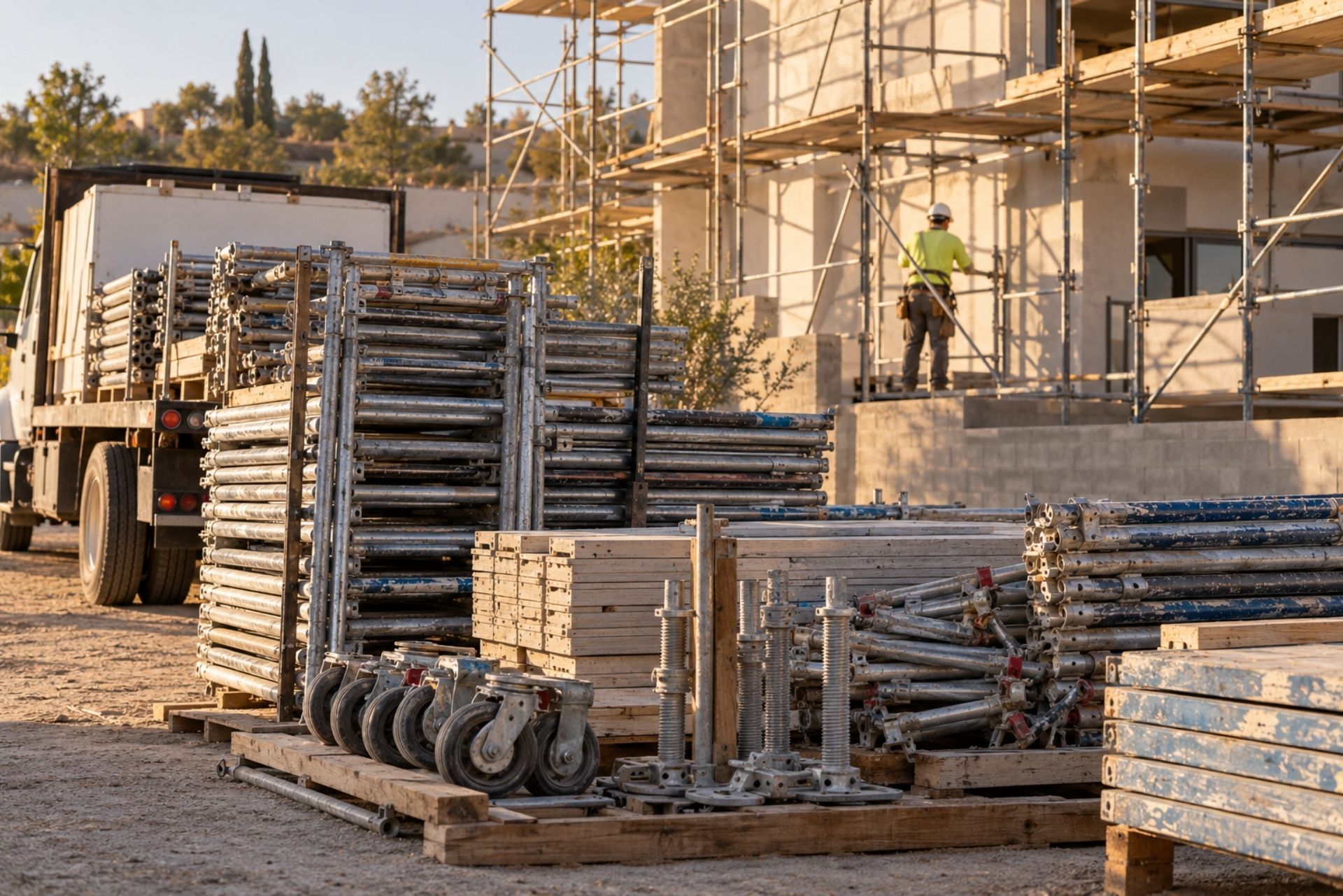
A scaffold that holds a crew of plasterers forty feet up a Los Angeles office tower is also holding up your entire business. If one plank fails, one tie-in pulls loose, or one worker steps off an unguarded edge, the resulting claims can easily exceed what a small or mid-sized contractor earns in several years.
That is why scaffolding contractor insurance in California deserves more attention than a once-a-year renewal call. Carriers treat this trade as one of the riskier classes in construction. General contractors scrutinize your paperwork before you unload a single frame. State regulators expect your workers' compensation to be active every day your crew is on site.
This guide covers the policies that matter, the claims that drive premiums, and the certificate requirements that can win or lose you a job. All dollar figures below are illustrative examples meant to show how the numbers work, not quotes. Use them as a framework when you sit down with your broker, and test every assumption against your own payroll, contracts, and loss history.
Insurers price scaffolding work by asking one question: how bad could the worst day be? In this trade, the honest answer is very bad. A single incident can involve multiple injured workers, injured pedestrians, a damaged building facade, and crushed vehicles, all from one collapse.
California adds its own layers of exposure. Cal/OSHA enforces detailed scaffold standards under Title 8 of the California Code of Regulations, and a serious violation found after an accident can be used against you in a lawsuit. Jury verdicts in Los Angeles, Alameda, and San Francisco counties tend to run high. Seismic activity also matters, because carriers want to know how your systems are braced and tied to structures that can shift during an earthquake.
The market reflects all of this. Fewer standard carriers write pure scaffolding risks, so many contractors end up with excess and surplus lines insurers. Those policies can work well, but they often carry exclusions that admitted policies do not. Common examples include height limits, residential work exclusions, and action-over exclusions.
Before you compare prices, compare forms. A policy that is $8,000 cheaper but excludes work above three stories is not cheaper if most of your jobs are mid-rise.
By: Peter Plew
Commercial Insurance Agent at Caruso Insurance Services
General Liability and the Impact of Collapse and Fall Claims
General liability is the policy general contractors check first, and it is the one most likely to be tested by a serious claim. Collapse and fall incidents drive the majority of large scaffolding losses. Your GL policy's wording on these events determines whether you are protected or exposed.
Managing Third-Party Bodily Injury and Property Damage
Third parties include anyone who is not your employee. That means other trades on the site, the property owner's staff, delivery drivers, and pedestrians walking under your sidewalk canopy. A dropped coupler that strikes a passerby, or a scaffold that scrapes a storefront window, falls under your GL coverage.
The trickiest scenario is the action-over claim. An injured employee of another subcontractor sues the general contractor, and the GC then tenders the claim back to you under your contract. Many surplus lines policies exclude these claims or limit them heavily. For this trade, that exclusion is a serious problem. Ask your broker directly whether your policy covers action-over claims and contractual liability for injuries to other contractors' employees.
The Financial Consequences of Structural Collapse
Consider a hypothetical collapse on a four-story apartment retrofit in San Jose. The claims might include:
- Injured workers from two other trades: $1.8 million in combined settlements
- Facade and window damage: $240,000
- Three vehicles crushed in the parking area: $95,000
- Project delay costs claimed by the owner: $400,000
That totals more than $2.5 million. A $1 million per-occurrence GL limit with a $2 million aggregate leaves a large gap. This is why most commercial GCs require a $1 million/$2 million primary policy plus an umbrella or excess layer of $5 million or more. If an extra $5 million of excess costs $12,000 a year, one avoided uncovered judgment pays for well over a century of premiums.
Insurance for Erection, Dismantling, and Transit Operations
Many accidents in this trade do not happen while the scaffold is standing. They happen while it is going up, coming down, or riding on a flatbed down the 405. Your coverage needs to follow the equipment through every phase.
During erection and dismantling, the scaffold is incomplete and guardrails may not be in place yet. Some carriers apply different terms during this phase, so read your policy for any language limiting coverage during assembly. Some contractors also discover too late that their policy defines "completed operations" in a way that leaves a gap between when the scaffold is turned over to the GC and when it is struck.
Transit adds two more policies to the mix. Commercial auto covers liability when your trucks carry materials, and California's minimum limits are far too low for a loaded flatbed. Most contractors carry at least $1 million. An inland marine or contractor's equipment floater protects the frames, planks, and hardware themselves from theft, fire, or a rollover. That matters because a scaffolding inventory worth $400,000 or more is common for mid-sized firms.
Watch for these gaps:
- Equipment left overnight at a job site with no theft coverage
- Rented components that are not scheduled on your floater
- Unsecured loads that fall onto other vehicles, which can raise disputes between your auto and GL carriers
Workers' Compensation and Labor Law Compliance in California
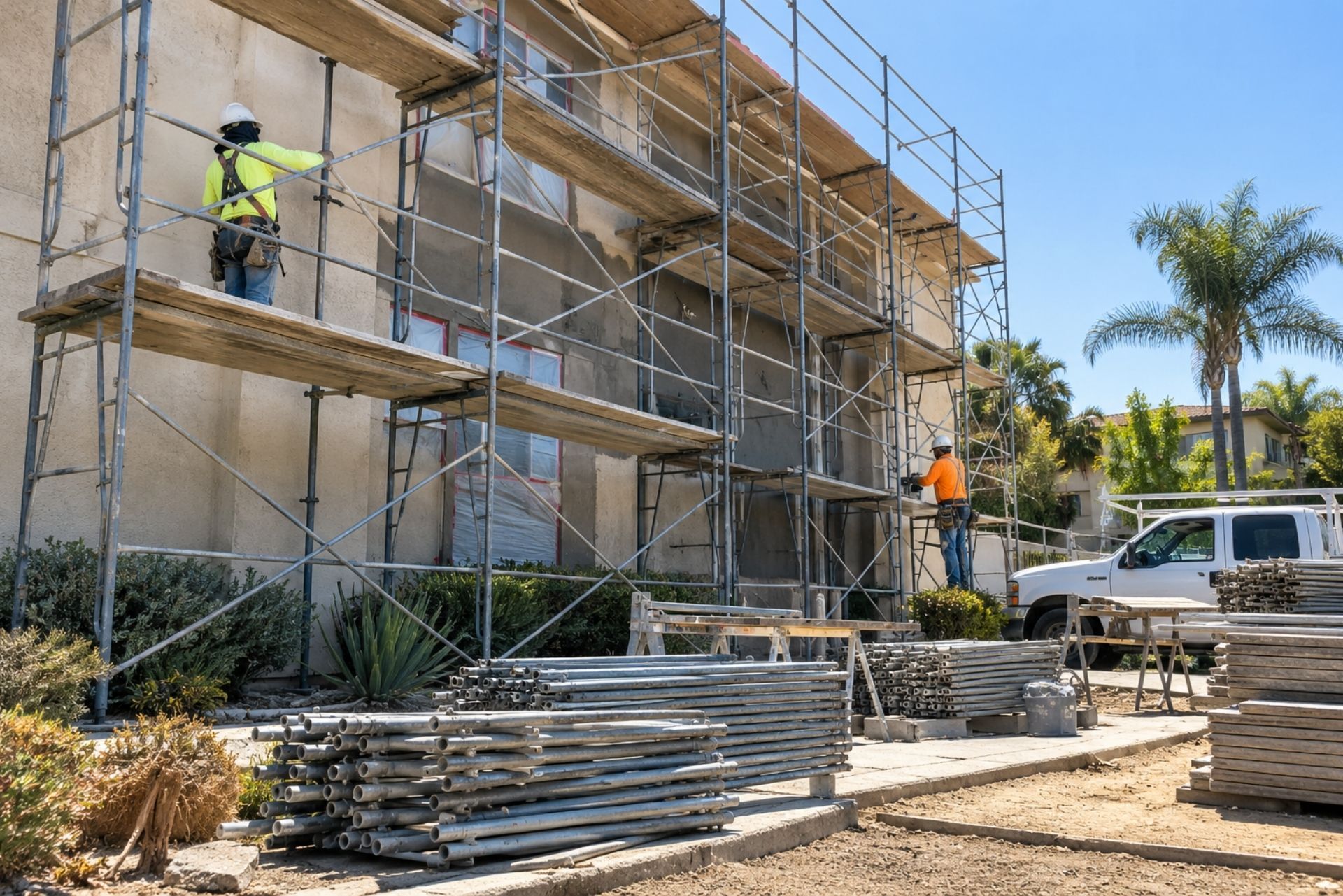
California requires every employer with even one employee to carry workers' compensation, and the state enforces that rule aggressively. Running a crew without coverage can lead to a stop-work order from the Labor Commissioner, penalties, and personal liability for every dollar of an injured worker's medical bills and lost wages. For a fall from height, that can mean decades of payments.
The Contractors State License Board also requires a workers' compensation certificate on file, or a valid exemption, to keep your license active. If your policy lapses, your license can be suspended. Treat your renewal date like a license expiration date, because in practice it is one.
Be careful with independent contractor arrangements. California applies the ABC test, and a scaffold erector working under your direction, on your equipment, doing your core business, is almost certainly your employee. If an injured "1099 worker" is reclassified after a fall, the uninsured claim lands on you.
Classification Codes and High-Altitude Payroll Rates
California workers' compensation premiums are built on classifications set by the Workers' Compensation Insurance Rating Bureau (WCIRB). Each classification carries a rate per $100 of payroll. Scaffolding work typically falls into higher-rated construction classes, and misclassification is one of the most common and costly errors in this trade.
Here is a simple example. If your field payroll is $1.2 million and your applicable rate is $18 per $100, your base premium is $216,000. An experience modification of 1.25 raises that to $270,000. Bring the mod down to 0.85, and the same payroll costs $183,600. That $86,400 difference comes almost entirely from your claims history. Carriers review three years of losses, so an injury this year affects pricing well into the future.
Keep office and estimating staff in their own clerical classification. Their payroll should not be rated as field labor.
Managing Certificates of Insurance and Additional Insured Status
A certificate of insurance is a one-page summary, and it does not grant coverage by itself. GCs know this, which is why they increasingly ask for the actual endorsements behind the certificate. Disorganized certificates delay payments, stall mobilization, and sometimes cost contractors the bid.
Meeting General Contractor and Project Owner Requirements
Most California GC subcontracts ask for some combination of the following:
- Additional insured status for the GC, the owner, and sometimes the lender, using both ongoing and completed operations endorsements
- Primary and non-contributory wording, meaning your policy responds before theirs
- Waiver of subrogation on GL, auto, and workers' compensation
- Per-project aggregate so one job's claims cannot exhaust your limits for everyone else
- 30-day notice of cancellation
Request blanket endorsements whenever possible. A blanket additional insured endorsement automatically covers anyone you agree in writing to add, so you do not need a new endorsement for every project. Blanket waivers of subrogation on workers' compensation usually cost a small percentage of premium. Paying a few thousand dollars a year is far easier than buying $250 endorsements job by job, and it shortens turnaround to hours instead of days.
Keep a tracking sheet with every active contract, its required limits, and its expiration dates. Send a reminder to your broker 45 days before renewal so updated certificates go out before the old ones lapse.
The cheapest premium comes from a clean loss history and an underwriting submission that shows discipline. Carriers reward contractors who can prove control over their risks.
Practices that make a measurable difference:
- Competent-person inspections documented daily, with dated photos stored by job
- Written fall protection and erection plans tied to Cal/OSHA requirements
- Scaffold user and erector training records for every worker
- Annual equipment audits that remove bent frames and cracked planks from service
- Higher deductibles, if your cash reserves can absorb them
Deductibles deserve a quick break-even check. Suppose moving from a $5,000 to a $25,000 GL deductible saves $9,000 a year. You come out ahead unless you have more than one claim roughly every two years. Only make that move if you have $25,000 in reserve right now. If you would have to borrow to pay a deductible, keep it low.
Think long term about every claim. Small claims follow you through loss runs that every future underwriter will request, and a pattern of minor incidents can push you into the surplus market or into restrictive exclusions. Some contractors pay a $3,000 property damage incident out of pocket to protect their record. That decision should be made carefully with your broker.
The best scaffolding insurance program is not the one with the lowest premium. It is the one where general liability, umbrella, auto, equipment, and workers' compensation fit together without gaps, and where certificates go out quickly whenever a GC asks. Review your policy forms, check your classifications, and verify your action-over coverage before your next renewal. Then schedule a meeting with a broker who writes scaffolding risks regularly and ask them to walk through your worst-case collapse scenario line by line. If they cannot explain which policy pays for each part of the loss, find one who can.
ABOUT THE AUTHOR:
PETER PLEW
Hi my name is Peter Plew and I am a commercial insurance professional. I listen to and strategize with business owners about their visions of the future and assist in getting there as quickly as possible. I help identify unique exposure and risk’s that business owners have and the reasons why they need to be insured against them. My goal is to make sure my clients are always taken care of on a daily basis with any service needs, questions, or concerns they may have. I love to golf and spend time with my family in my spare time.
Contact Us

Service that stays with you.
Our team helps simplify insurance decisions for families and businesses. We focus on clear explanations, fast responses, and dependable service. You can count on us for help with coverage questions, updates, and long-term support.
Coverage that keeps you secure
Reliable Protection for Everyday Life
Home insurance helps protect your house, personal belongings, and liability risks. We explain coverage options clearly so you know what your policy includes.
Auto insurance provides protection for accidents, liability, and vehicle damage. We help you compare options so you can choose coverage that fits your driving needs.
Motorcycle insurance provides coverage for riders and their bikes. We help you select options that match how and where you ride.
RV insurance supports protection for motorhomes and recreational vehicles. Coverage applies during travel and while parked.
Coverage Built for Contractors and Trades
Support that keeps your work moving.

General Liability Insurance
General liability insurance helps protect contractors from injury and property damage claims. It supports jobsite requirements and contracts.

Workers Compensation
Workers compensation insurance helps protect employees injured while working. It also supports compliance with state requirements.

Commercial Auto Insurance
Commercial auto insurance provides coverage for work vehicles used on jobsites. It helps protect drivers and company vehicles.
Contractor Insurance
Contractor insurance supports trades and service professionals across Southern California. It helps protect tools, equipment, and daily operations.

Cyber Liability Insurance
Cyber liability insurance helps protect business data and customer information. It supports recovery from digital incidents.

Commercial Property Insurance
Commercial property insurance helps protect offices, shops, and equipment. It supports recovery after covered damage.
Coverage Built for Specialized Work
Support for high-risk and service-driven industries.



Simple Steps Supported by Steady Guidance
A Clear Path to Coverage
Trusted by Clients Across Southern California
Clear service backed by real experiences.
Answers to Common Questions.
Clear explanations to guide your decisions.
How do I know which insurance policy is right for me?
We compare coverage options from multiple carriers to help you see differences in protection and price. You can review clear details and ask questions so you understand what each policy covers. Our team guides you step by step so you feel sure about your decision.
What factors affect my auto insurance premium?
Auto insurance premiums are influenced by your driving history, age, location, vehicle type, and coverage choices. A clean driving record and good safety features can help lower costs. We review these factors with you and help find coverage that fits your budget and needs.
Does homeowners insurance cover all types of damage?
Standard homeowners insurance protects your structure, personal belongings, liability, and additional living expenses in many cases. However, it usually does not include flood or earthquake damage without separate policies. We help you decide if extra coverage is right for your home and location.
Can I update my policy or get certificates online?
Yes. You can submit requests for policy changes and certificates through our online service form at any time. Our team processes those requests quickly and confirms updates once complete so you have the documents you need.
Do I need separate insurance for business risks like EPLI or E&O?
Yes. General liability and workers compensation cover many business risks but do not protect against all exposures. For example, Employment Practices Liability Insurance (EPLI) covers claims like wrongful termination or discrimination, and Errors & Omissions (E&O) covers claims based on mistakes in professional services. We help you identify which extra policies your business may need.
What happens if I need to file a claim?
If you need to file a claim, we guide you through the process and help you contact the insurance carrier. We explain what information you should provide, answer your questions, and stay available while the carrier reviews your claim. This support helps you move forward with confidence.
Contact Us