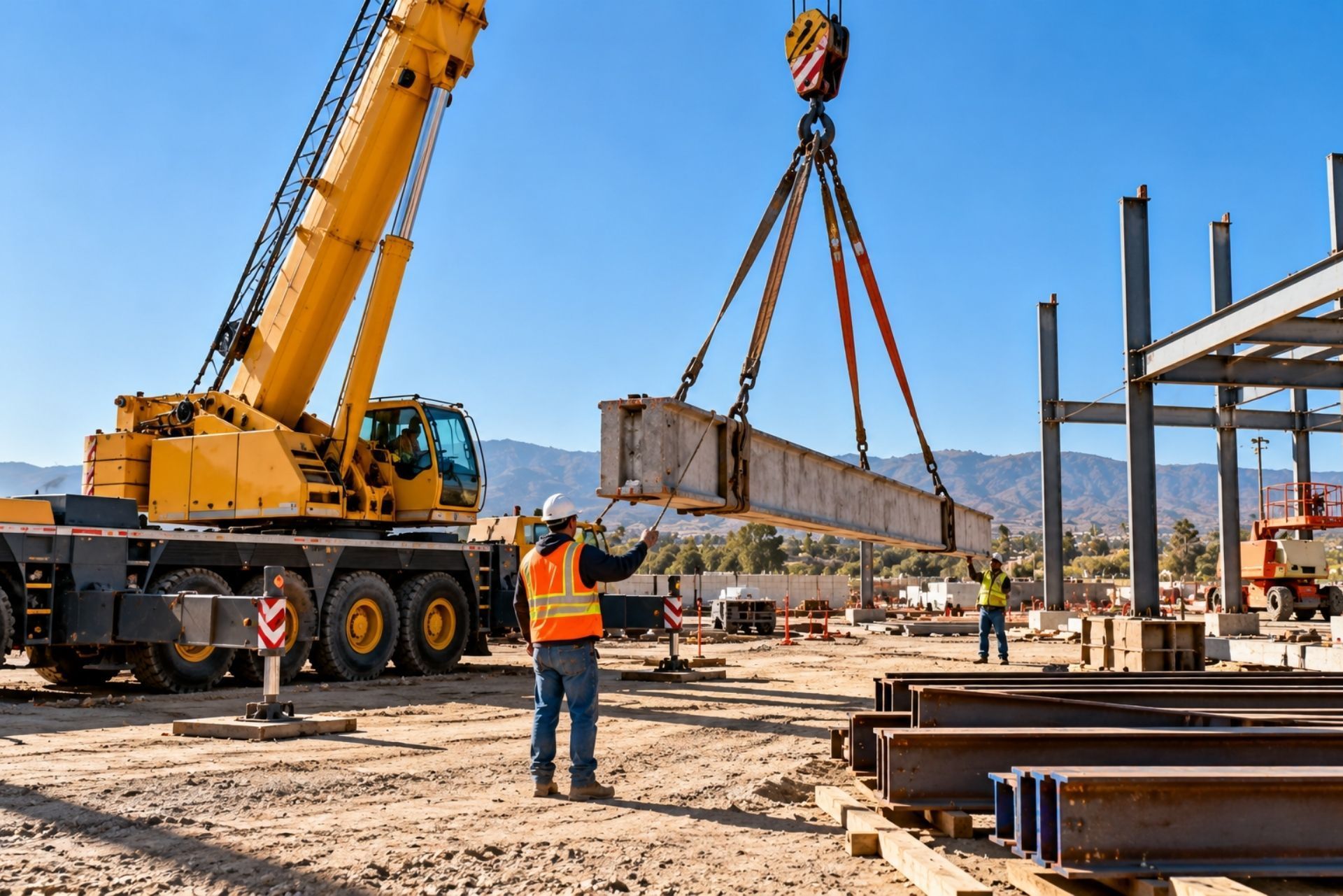
California crane work carries a particular kind of exposure. A single dropped load can crush a customer's HVAC unit, shut down a freeway lane, and send an operator to the hospital, all before lunch. Contractors who grew from a single truck crane into a multi-unit fleet often discover their insurance never grew with them. They are carrying a general liability policy written for a small trade contractor and assuming it covers everything.
It doesn't. A sound crane and rigging insurance program in California has five distinct parts. Each one fills a gap the others leave open, and the gaps are where six-figure claims land.
This guide covers riggers liability, crane physical damage, general liability, workers' compensation, and umbrella limits. It explains what each policy actually pays for and how to structure limits so a general contractor's certificate request doesn't cost you a bid. It also covers how to keep premiums from climbing faster than revenue.
California adds layers of risk that crane operators in many other states never face. Seismic retrofit projects, tilt-up warehouse construction in the Inland Empire, and tight urban picks in San Francisco and Los Angeles all bring their own hazards. Each job type puts heavy loads close to people, structures, and power lines.
Regulation is part of the picture too. Cal/OSHA's Title 8 crane standards require operator certification and annual inspections of cranes by accredited certifiers. An insurer reviewing your application will ask whether those certifications are current. If a crane goes over during a lift and its annual certification had lapsed, expect a hard conversation with your adjuster and a harder one at renewal.
Geography matters as well. Wildfire seasons now routinely affect equipment parked at remote yards or job sites. Earthquake exposure is a real factor for cranes stored near fault zones. Santa Ana winds can stop lifts entirely or turn a routine pick into a load swing incident.
Underwriters price all of this. They look at crane capacities, your mix of bare rental and operated rental, the projects you take on, and your loss history. Contractors who understand that pricing logic negotiate from a stronger position.
By: Peter Plew
Commercial Insurance Agent at Caruso Insurance Services
Core Liability Protections: General Liability and Riggers Legal
These two policies get confused constantly, and the confusion is expensive. General liability covers injury and damage to third parties. Riggers liability covers the property you are actually lifting. They are not interchangeable.
The Critical Role of Riggers Liability for Property Under Hook
Standard general liability policies contain a "care, custody, or control" exclusion. Once a customer's transformer, generator, or rooftop chiller is on your hook, it's in your control. If it drops, your GL policy will likely deny the claim.
Riggers liability (sometimes called "riggers legal" or "property under hook" coverage) fills that hole. Take a $400,000 piece of medical imaging equipment being set into a hospital. If a sling fails, riggers coverage pays to repair or replace it.
Pay attention to two terms:
- Legal liability vs. direct form: Legal liability pays only if you're found negligent. Direct form pays regardless of fault, which keeps customer relationships intact.
- Per-item limits: Your limit must match the most valuable thing you lift, not your average pick.
General Liability and Third-Party Bodily Injury Exposures
General liability responds when your operations hurt someone or damage property you aren't handling. Examples include a swinging load that strikes a passing vehicle, or outriggers that crack a customer's driveway. Most California GCs require $1 million per occurrence and $2 million aggregate, plus additional insured status and a waiver of subrogation. Check that your policy doesn't carry a crane or height exclusion. Some cheaper carriers bury one in the endorsements.
Protecting Assets with Crane Physical Damage and Inland Marine
Your cranes are probably your largest balance-sheet assets. Auto policies rarely cover mobile cranes properly. That's why crane physical damage is written on an inland marine form, often as part of a contractor's equipment floater.
Valuation Methods: Actual Cash Value vs. Replacement Cost
Here is where contractors lose real money. Say you own a 2018 all-terrain crane that would cost $1.2 million to replace new today. Its depreciated actual cash value might be $650,000. If it's totaled and you're insured at ACV, you receive $650,000 minus your deductible. You then have to finance the $550,000 difference while the work you'd booked goes to a competitor.
Replacement cost coverage might add 10 to 20 percent to your inland marine premium. On a $20,000 annual premium, that's roughly $2,000 to $4,000 more per year. Compare that to a $550,000 shortfall: you'd need well over a century of premium savings to break even on one total loss. For newer or hard-to-source cranes, replacement cost or agreed value is usually the smarter choice. Keep valuations current, because underinsuring can trigger coinsurance penalties.
Coverage for Boom Collapse and Overload Scenarios
Read the exclusions closely. Many inland marine forms exclude damage caused by overloading or exceeding the manufacturer's rated capacity, and some exclude boom damage entirely. Ask specifically for boom collapse and overturn coverage. Ask about rental reimbursement too, which pays for a replacement crane while yours is down. Downtime on a single unit can cost more than the repair itself.
California Workers' Compensation and Safety Compliance
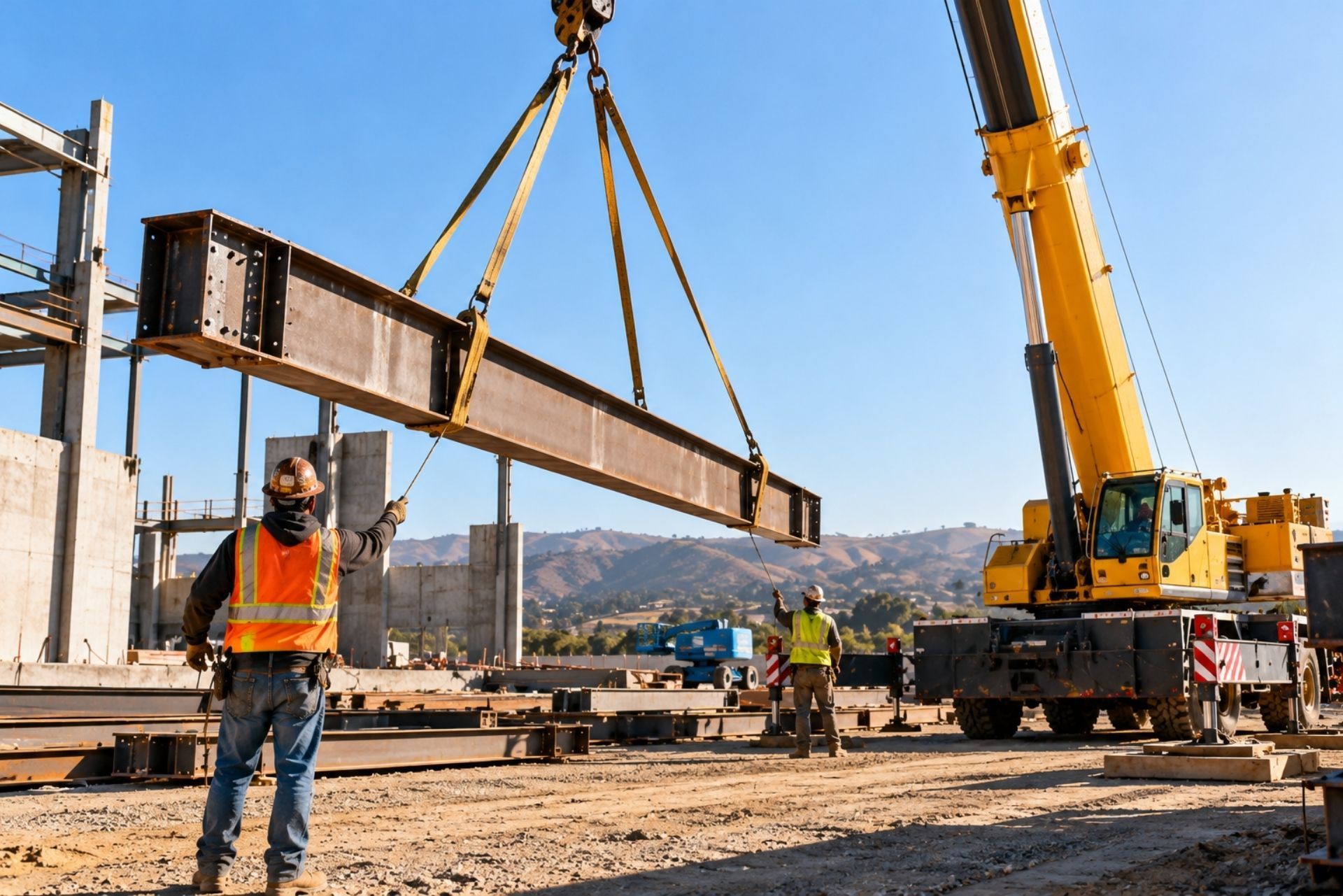
Every California employer with employees must carry workers' compensation. Crane operation and rigging fall into some of the costlier classification codes in the state. The WCIRB sets the classification system and calculates your experience modification rate (EMod), the multiplier that rewards or punishes your claims record.
The EMod effect is dramatic. Consider a contractor with $1.5 million in payroll and a manual premium of $90,000. At a 0.80 EMod they pay about $72,000. At 1.30 they pay about $117,000. That $45,000 gap comes from claims history alone, and it lasts for years because the mod is based on a rolling three-year window.
Your loss runs follow you in the same way. Commercial underwriters request five years of loss runs, much as homeowners carriers check CLUE reports. A bad year in 2024 will still affect quotes in 2027.
Practical steps that lower that number:
- Keep every operator's NCCCO or equivalent certification current, and keep copies on file
- Hold documented daily pre-lift inspections and toolbox talks
- Report claims promptly; delayed reporting makes claims more expensive
- Build a return-to-work program with modified duty, which keeps indemnity costs down
Payroll audits happen every year. Classify riggers, operators, and office staff accurately, or you'll get a surprise bill at audit.
The Necessity of Excess Liability and Umbrella Limits
A $1 million GL limit evaporates fast in a crane catastrophe. A serious injury to a third party in California, especially one involving long-term care or lost earnings, can produce a verdict far above that figure. Jury awards in the state have grown sharply in recent years, a trend the industry calls social inflation.
Umbrella and excess policies sit on top of your general liability, commercial auto, and employer's liability limits. Once a primary policy is exhausted, they pay. Many large GCs, public agencies, and refinery or utility owners now require $5 million to $10 million in excess limits. Some energy and infrastructure projects require $25 million or more.
A few things to confirm before you buy:
- Follow form: The umbrella should follow the terms of the underlying policies, so you don't find new exclusions in the excess layer
- Crane-specific exclusions: Some umbrellas exclude cranes over a certain tonnage
- Auto inclusion: Your crane trucks travel public roads, so the umbrella must sit over commercial auto
Pricing for excess layers has tightened, and a $5 million umbrella for a crane contractor costs considerably more than one for a landscaper. Run the numbers against the contracts you're losing without higher limits. A single refinery shutdown job can pay for years of premium.
Underwriters reward contractors who can document their safety record. The cheapest crane and rigging policy in California isn't always the best one. The best program is the one with fair pricing and no hidden exclusions waiting to sink a claim.
These steps tend to move premiums:
- Inspect and document everything. Keep annual certification reports, monthly maintenance logs, and dated photos of rigging gear. Bring them to renewal.
- Formalize lift planning. Write critical lift plans for any pick above 75 percent of rated capacity or involving multiple cranes.
- Review contracts before signing. Watch for indemnity clauses that push the GC's negligence onto you. Know what your bare rental and operated rental agreements say about who insures what.
- Market your account every two to three years. Use a broker who specializes in crane and rigging accounts and has access to carriers that actually write the class.
- Protect your loss history. Small property-under-hook claims might be cheaper to pay out of pocket than to file and carry on your loss runs for five years.
A complete program puts riggers liability on the loads, inland marine on the iron, GL and workers' comp under the operation, and an umbrella over all of it. Have each piece reviewed every year, before a GC's certificate request or a dropped load forces the issue. Pull your current policies this week. Check your
valuation basis, your riggers per-item limit, and your umbrella's tonnage exclusions. If any answer surprises you, call your broker before your next lift.
ABOUT THE AUTHOR:
PETER PLEW
Hi my name is Peter Plew and I am a commercial insurance professional. I listen to and strategize with business owners about their visions of the future and assist in getting there as quickly as possible. I help identify unique exposure and risk’s that business owners have and the reasons why they need to be insured against them. My goal is to make sure my clients are always taken care of on a daily basis with any service needs, questions, or concerns they may have. I love to golf and spend time with my family in my spare time.
Contact Us

Service that stays with you.
Our team helps simplify insurance decisions for families and businesses. We focus on clear explanations, fast responses, and dependable service. You can count on us for help with coverage questions, updates, and long-term support.
Coverage that keeps you secure
Reliable Protection for Everyday Life
Home insurance helps protect your house, personal belongings, and liability risks. We explain coverage options clearly so you know what your policy includes.
Auto insurance provides protection for accidents, liability, and vehicle damage. We help you compare options so you can choose coverage that fits your driving needs.
Motorcycle insurance provides coverage for riders and their bikes. We help you select options that match how and where you ride.
RV insurance supports protection for motorhomes and recreational vehicles. Coverage applies during travel and while parked.
Coverage Built for Contractors and Trades
Support that keeps your work moving.

General Liability Insurance
General liability insurance helps protect contractors from injury and property damage claims. It supports jobsite requirements and contracts.

Workers Compensation
Workers compensation insurance helps protect employees injured while working. It also supports compliance with state requirements.
Commercial Auto Insurance
Commercial auto insurance provides coverage for work vehicles used on jobsites. It helps protect drivers and company vehicles.
Contractor Insurance
Contractor insurance supports trades and service professionals across Southern California. It helps protect tools, equipment, and daily operations.

Cyber Liability Insurance
Cyber liability insurance helps protect business data and customer information. It supports recovery from digital incidents.

Commercial Property Insurance
Commercial property insurance helps protect offices, shops, and equipment. It supports recovery after covered damage.
Coverage Built for Specialized Work
Support for high-risk and service-driven industries.
Simple Steps Supported by Steady Guidance
A Clear Path to Coverage
Trusted by Clients Across Southern California
Clear service backed by real experiences.
Answers to Common Questions.
Clear explanations to guide your decisions.
How do I know which insurance policy is right for me?
We compare coverage options from multiple carriers to help you see differences in protection and price. You can review clear details and ask questions so you understand what each policy covers. Our team guides you step by step so you feel sure about your decision.
What factors affect my auto insurance premium?
Auto insurance premiums are influenced by your driving history, age, location, vehicle type, and coverage choices. A clean driving record and good safety features can help lower costs. We review these factors with you and help find coverage that fits your budget and needs.
Does homeowners insurance cover all types of damage?
Standard homeowners insurance protects your structure, personal belongings, liability, and additional living expenses in many cases. However, it usually does not include flood or earthquake damage without separate policies. We help you decide if extra coverage is right for your home and location.
Can I update my policy or get certificates online?
Yes. You can submit requests for policy changes and certificates through our online service form at any time. Our team processes those requests quickly and confirms updates once complete so you have the documents you need.
Do I need separate insurance for business risks like EPLI or E&O?
Yes. General liability and workers compensation cover many business risks but do not protect against all exposures. For example, Employment Practices Liability Insurance (EPLI) covers claims like wrongful termination or discrimination, and Errors & Omissions (E&O) covers claims based on mistakes in professional services. We help you identify which extra policies your business may need.
What happens if I need to file a claim?
If you need to file a claim, we guide you through the process and help you contact the insurance carrier. We explain what information you should provide, answer your questions, and stay available while the carrier reviews your claim. This support helps you move forward with confidence.
Contact Us