See How We're Different
or Call Us: 951-547-6770
Why Window Cleaning Liability Insurance Is Critical for Your Business
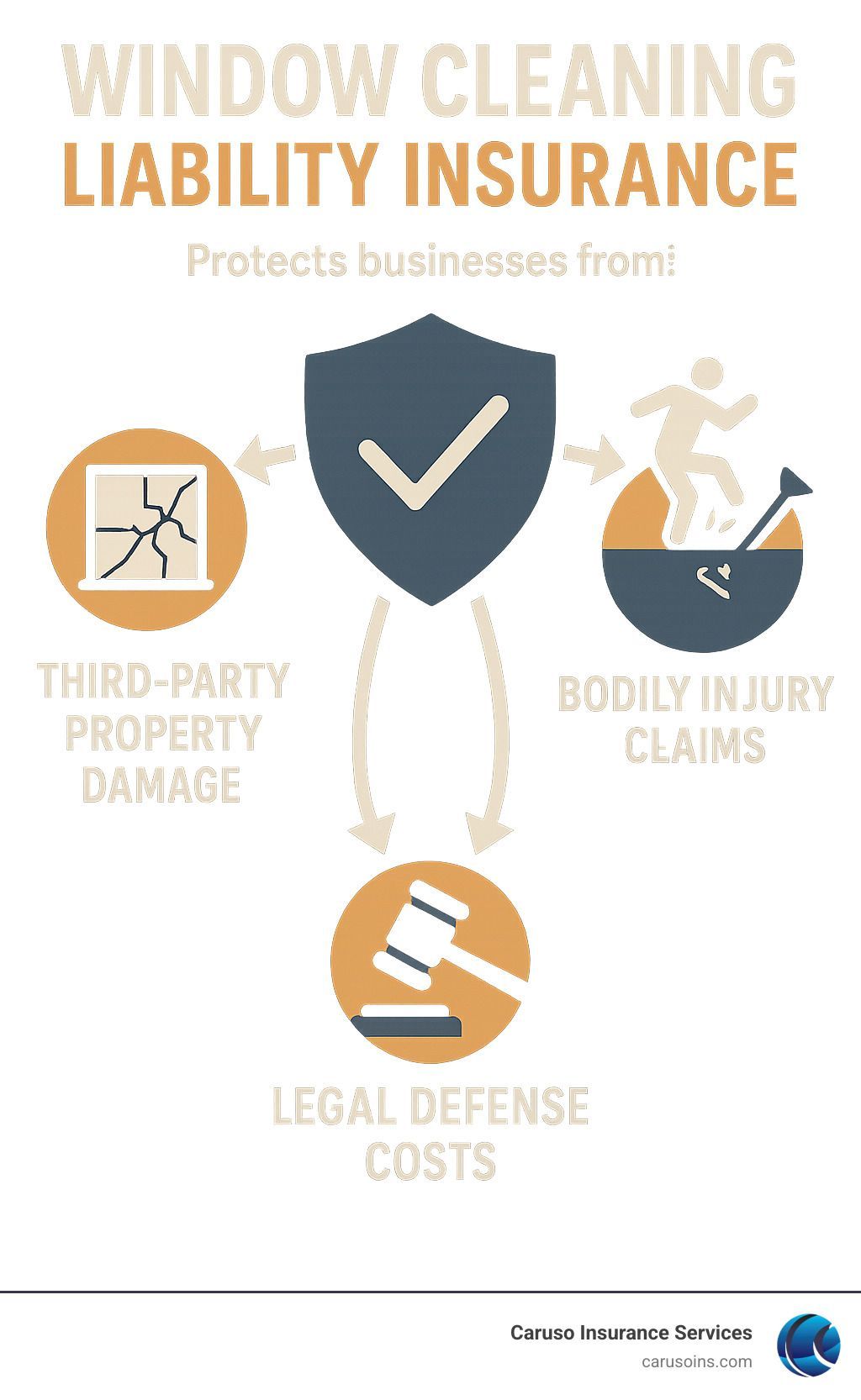
Window cleaning liability insurance protects your business from costly claims when accidents happen on the job. This specialized coverage shields you from third-party property damage, bodily injury lawsuits, and legal defense costs that could otherwise bankrupt your business.
Key Coverage Areas for Window Cleaners:
- Third-party property damage – Broken windows, damaged siding, scratched vehicles
- Bodily injury claims – Client injuries from slips, falls, or falling equipment
- Legal defense costs – Attorney fees and court expenses
- Completed operations – Claims arising after job completion
- Coverage limits – Typically $1-2 million per occurrence
Window cleaning might look straightforward, but the risks are real and expensive. Consider this sobering example: a simple $50 window cleaning job turned into $27,000 in damages when things went wrong. Even experienced professionals face accidents – a dropped squeegee can crack a car windshield, a ladder can slip and break expensive landscaping, or cleaning solutions can permanently stain a client’s siding.
Most commercial and residential clients now require proof of liability insurance before they’ll hire you. Without it, you’re locked out of the best-paying jobs and left vulnerable to financial disaster from a single accident.
As Patrick Caruso, an independent commercial insurance specialist, I’ve helped countless window cleaning businesses in Colorado, Arizona, Florida, Nevada, Texas, Tennessee, and Idaho secure the right
window cleaning liability insurance coverage. My experience shows that the right policy not only protects your assets but also opens doors to higher-value contracts that require proof of insurance.
Window cleaning liability insurance terms you need:
- basic business liability insurance
- basic liability insurance for small business
- fitness liability insurance
Why Every Window Cleaner Faces Unexpected Risks
Every day, window cleaners across the country head out to work, armed with squeegees, ladders, and cleaning solutions. What many don’t realize is that they’re also carrying invisible risks that could destroy their business in a single afternoon.
The reality is sobering: window cleaning combines physical labor, specialized equipment, and often dangerous heights. When something goes wrong, it goes wrong fast and expensive.
Third-party property damage represents your biggest everyday threat. Picture this: you’re cleaning windows on a beautiful home when your squeegee slips from wet hands. Instead of hitting the ground, it crashes through the homeowner’s prized antique garden statue worth thousands of dollars. Or maybe your ladder shifts unexpectedly, gouging the client’s expensive siding. Chemical cleaning solutions can permanently stain surfaces if they’re not handled perfectly every single time.

The financial impact can be staggering. A recent case shows just how quickly costs spiral out of control—a $50 job turned into $27,000 in damages when things went sideways. That’s not a typo. A simple window cleaning job turned into a financial nightmare that could bankrupt most small businesses.
Bodily injury claims add another layer of risk that keeps smart business owners up at night. A client could trip over your equipment hose while you’re working. A pedestrian might be struck by a tool that falls from height. Even something as innocent as a wet spot left behind could cause someone to slip and get seriously hurt.
These accidents don’t just happen to other people. They happen to experienced professionals who’ve been cleaning windows for years. The difference between businesses that survive these incidents and those that don’t often comes down to having proper window cleaning liability insurance in place.
Legal defense costs can drain your business account faster than the actual damages. Even when you’re not at fault, defending yourself against a lawsuit costs serious money. Attorney fees, court costs, and expert witnesses add up quickly. Without insurance coverage, you’re paying these expenses out of your own pocket while trying to keep your business running.
Client requirements have made insurance coverage essential for landing good contracts. Most commercial property managers won’t even talk to you without proof of insurance. Residential clients are getting smarter too – they want to see that certificate of insurance before you touch their property. Without coverage, you’re automatically disqualified from the best-paying jobs.

Who Needs This Essential Coverage?
The simple answer is everyone who cleans windows professionally, even part-time. The risks don’t care about the size of your operation or how careful you think you are.
Residential cleaners face constant exposure to expensive property and liability claims. Homeowners have invested heavily in their properties, and they expect you to work around valuable landscaping, decorative items, and pristine surfaces. One mistake can cost thousands.
Commercial cleaners deal with higher stakes every day. Storefronts, office buildings, and retail spaces see heavy foot traffic, increasing the chances of someone getting hurt. The property values are typically higher, and business owners are quick to protect their investments through legal action when necessary.
High-rise specialists work in the most dangerous conditions in the industry. Working at extreme heights with specialized equipment like scaffolding and aerial lifts multiplies every risk. When accidents happen at height, they tend to be catastrophic and expensive.
Sole proprietors need protection more than anyone because they’re personally on the hook for every dollar of damage or injury claims. Your personal assets – your house, your savings, your future earnings – are all at risk without proper insurance coverage.
Part-time operators sometimes think they can skip insurance because they don’t work full-time. This is dangerous thinking. Accidents don’t check your schedule before they happen. A weekend side job can turn into a financial disaster just as easily as a full-time operation.
Whether you’re operating in Colorado, Arizona, Florida, Nevada, Texas, Tennessee, or Idaho, the fundamental need for window cleaning liability insurance remains the same. State regulations might vary slightly, but the protection you need stays consistent across all these markets.
The bottom line is simple: if you’re cleaning windows for money, you need liability insurance. The question isn’t whether you can afford the coverage – it’s whether you can afford to operate without it.
What Does Window Cleaning Liability Insurance Actually Cover?
When you’re shopping for window cleaning liability insurance, you’ll mainly be looking at Commercial General Liability (CGL) insurance. Think of it as your business’s safety net – the thing that catches you when life throws those unexpected curveballs that could otherwise wipe out everything you’ve worked to build.
Your CGL policy acts like a financial shield between your business and the costly surprises that can pop up in this line of work. The beauty of a solid policy is that it covers the big stuff that keeps business owners awake at night.
Third-party property damage is probably what you’ll deal with most often. Picture this: you’re having a perfectly normal day, cleaning windows like you’ve done thousands of times before, when suddenly your squeegee slips and cracks an expensive piece of glass. Or maybe your ladder shifts and damages a client’s prized rose bushes. Your policy steps in to cover those repair and replacement costs, so you don’t have to dig into your business savings or personal funds.
Third-party bodily injury coverage protects you when someone gets hurt because of your work. Maybe a homeowner trips over your equipment, or a passerby gets injured by a piece of gear that falls from height. These situations can lead to hefty medical bills and potential lawsuits – but your insurance helps cover those costs and legal fees.
Here’s something many window cleaners don’t think about: completed operations coverage. This protects you even after you’ve packed up and left the job site. Let’s say a window you cleaned develops a crack a week later, and the client claims it was due to your work. Or maybe a cleaning solution you used causes staining that doesn’t show up until days later. This coverage has your back for those delayed claims.
Advertising injury might seem less relevant for window cleaners, but it’s still valuable protection. If someone claims your marketing materials damaged their reputation or infringed on their copyright, this coverage helps with legal defense costs.
For a deeper dive into how all these pieces fit together, check out The Ultimate Guide to Business Liability Insurance Coverage.
How a Policy Protects You from Common Claims
Let me paint you some real-world pictures of how window cleaning liability insurance saves the day. These aren’t far-fetched scenarios – they’re the kind of things that happen to good, careful professionals every week.
Squeegee drops on a car – You’re working on a second-story window, and despite your best grip, that squeegee slips right out of your hands. It lands squarely on your client’s BMW, leaving a nice spider-web crack across the windshield. Without insurance, you’re looking at an $800+ repair bill coming straight out of your pocket. With coverage, your policy handles it while you get back to work.
Ladder slips and breaks a window – Even the most experienced pros have moments when physics doesn’t cooperate. Your ladder shifts unexpectedly, crashes into a large picture window, and suddenly you’re staring at thousands of dollars in custom glass replacement. Your third-party property damage coverage takes care of the bill.
Chemical solution stains siding – You’re trying a new eco-friendly cleaner, but it reacts poorly with the client’s vinyl siding, leaving permanent discoloration. The homeowner wants the entire side of their house re-sided. That’s a job that could easily run $10,000 or more – exactly the kind of situation your policy was designed to handle.
A client trips over your hose – You’ve got your water hose running across a walkway (it happens to all of us), and the client’s elderly mother doesn’t see it. She takes a tumble, breaks her wrist, and now you’re facing medical bills and a potential lawsuit. Your bodily injury coverage steps in to protect both her and your business.
These everyday accidents show why having solid window cleaning liability insurance isn’t just smart – it’s essential for staying in business. When clients see that you’re properly insured, they know you’re a professional who takes responsibility seriously.
Most commercial clients and many residential customers will ask for a Certificate of Liability Insurance before they’ll even consider hiring you. This simple document proves you’re covered and ready to handle whatever comes your way.
Decoding the Cost of Your Policy
When it comes to window cleaning liability insurance, the price tag isn’t one-size-fits-all. While you might see starting prices around $450 per year for a $2 million coverage limit, your actual premium depends on several unique factors about your business.
Think of it like getting a custom-custom suit – the final cost reflects your specific measurements and needs. Your business location plays a surprisingly big role in pricing. Operating in Colorado might cost differently than working in Arizona, Florida, Nevada, Texas, Tennessee, or Idaho due to varying legal environments and local claim frequencies.
The services you offer significantly impact your rates, especially when heights are involved. Cleaning ground-level residential windows carries different risks than scaling high-rise commercial buildings with specialized equipment. Insurance companies pay close attention to whether you’re using ladders, aerial lifts, or cradles – the higher you go, the higher your premium typically climbs.
Your number of employees matters too. A solo operation naturally costs less to insure than a crew of five. Each additional team member represents more potential for accidents, which insurers factor into their calculations.
Your claims history acts like a report card for your business. A clean record with no previous claims can earn you lower premiums, while frequent claims signal higher risk to insurers. It’s one of the strongest arguments for maintaining excellent safety practices.
Coverage limits directly influence cost – choosing $2 million in coverage costs more than $1 million, but many commercial clients now require the higher amount. Your deductible choice also affects pricing; selecting a higher amount you’ll pay out-of-pocket can lower your annual premium.
For a deeper dive into business liability insurance costs across different industries, check out our comprehensive guide: How Much Does Business Liability Insurance Cost?.
How to Get the Most Affordable Window Cleaning Liability Insurance
Smart shopping can save you hundreds of dollars annually on window cleaning liability insurance without sacrificing essential protection. The key is knowing where to look and what strategies actually work.
Bundling policies often delivers the biggest savings. When you combine your liability insurance with commercial auto or other business coverage, insurers typically offer attractive discounts. A comprehensive package might start around $575 annually, but bundling can bring that down significantly.
Increasing your deductible responsibly can lower your premium, but don’t go overboard. Choose an amount you can comfortably afford if you need to file a claim. There’s no point saving $100 on premiums if you can’t handle a $2,500 deductible when accidents happen.
Maintaining a strong safety record pays dividends over time. Implement solid safety protocols, train your team regularly, and inspect equipment consistently. Insurance companies reward businesses that demonstrate they take risk management seriously.
Choosing only necessary coverage prevents overpaying for protection you don’t need. If you’re a sole proprietor, you likely don’t need workers’ compensation. If you only work on single-story buildings, you might not need the same coverage as high-rise specialists.
The most effective strategy? Compare quotes from multiple insurers. Different companies assess risk differently, and their pricing can vary substantially. What one insurer sees as high-risk, another might view as manageable, leading to significantly different premium quotes for identical coverage.
Keep your employee count accurate and update your insurer when it changes. An outdated count can lead to unnecessary costs or inadequate coverage. Similarly, ensure your equipment values are current – over-insuring drives up premiums while under-insuring leaves you vulnerable.
These strategies can meaningfully reduce your
window cleaning liability insurance costs while keeping your business properly protected against the unexpected challenges that come with the territory.
Beyond Liability: Other Essential Insurance for Window Cleaners
While window cleaning liability insurance forms the foundation of your protection, running a complete window cleaning business means thinking beyond just liability coverage. It’s like having a perfectly clean window – the glass might be spotless, but without a solid frame and proper seals, you’re still vulnerable to the elements.
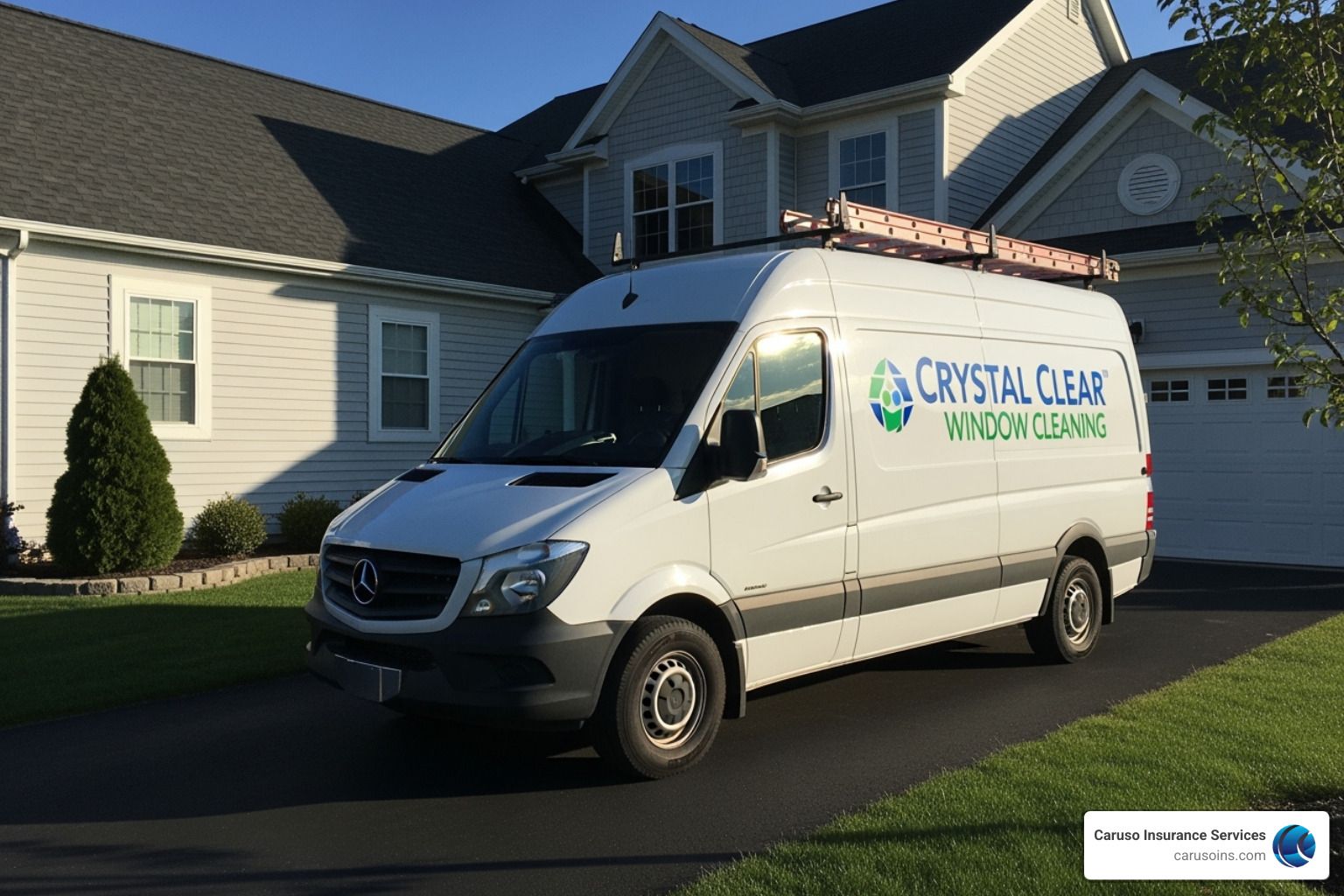
Your business faces risks that go far beyond accidentally breaking a client’s property or someone getting hurt on the job. What happens if your expensive equipment gets stolen from your van? What if an employee gets injured while working? What about the vehicle that carries your livelihood from job to job?
Key Coverages to Consider
The smartest window cleaning business owners build a complete insurance portfolio that covers every angle of their operation. Here’s what we recommend adding to your window cleaning liability insurance foundation:
Workers’ Compensation Insurance isn’t optional if you have employees – it’s required by law in Colorado, Arizona, Florida, Nevada, Texas, Tennessee, and Idaho. This coverage takes care of medical bills and lost wages when your team members get hurt on the job. Given that window cleaning involves ladders, heights, and physical demands, workplace injuries aren’t just possible – they’re unfortunately common. Without workers’ comp, a single fall could cost your business tens of thousands of dollars.
Commercial Auto Insurance protects the vehicles that keep your business moving. Your personal car insurance won’t cover accidents that happen while you’re driving to job sites or hauling equipment. Even worse, using your personal vehicle for business purposes could void your personal policy entirely. Commercial auto coverage ensures you’re protected whether you’re driving a work van full of equipment or using your personal truck to get to a client’s house. Drive your business forward with the right protection.
Tools & Equipment Coverage (also called Inland Marine insurance) protects your most valuable business assets – your tools and equipment. A basic CGL policy won’t replace your stolen squeegees, damaged water-fed poles, or expensive aerial lift equipment. This coverage follows your tools wherever they go, whether they’re stolen from a job site, damaged in transport, or destroyed in storage. Generally, items under $1,500 are considered “tools” while anything over that threshold counts as “equipment.”
Fidelity Bonds might sound fancy, but they’re really about building trust with your clients. These bonds (sometimes called janitorial bonds) protect your customers if one of your employees steals from them. Many commercial clients and high-end residential customers require this coverage before they’ll hire you. It’s essentially a guarantee that if your employee takes something that doesn’t belong to them, your client will be compensated for their loss.
The beauty of building a comprehensive insurance package is that it often costs less than buying each policy separately. Many insurers offer significant discounts when you bundle multiple coverages together, and you get the convenience of working with one agent who understands your entire business operation.
Every window cleaning business is different. A solo operator cleaning residential windows has different needs than a company with ten employees handling high-rise commercial buildings. That’s why we take the time to understand your specific operation and build a custom insurance package that fits your business like a perfectly measured squeegee fits your hand.
Frequently Asked Questions about Window Cleaning Insurance
When it comes to window cleaning liability insurance, we hear the same questions time and time again from business owners across Colorado, Arizona, Florida, Nevada, Texas, Tennessee, and Idaho. Let me address the most common concerns that keep window cleaning professionals up at night.
How much coverage do I really need for my window cleaning business?
This is honestly one of the trickiest questions we get, and for good reason – there’s no magic number that works for everyone. Your coverage needs depend on several key factors that we’ll walk through together.
Project size makes a huge difference. If you’re primarily cleaning residential windows on single-story homes, a $1 million policy might feel comfortable. But the moment you start tackling commercial buildings or high-rise work, you’re looking at a different risk profile entirely. Most commercial clients won’t even consider hiring you without at least $2 million in coverage.
Client contracts often make the decision for you. Many property managers and commercial clients will spell out exactly what coverage they require – sometimes $2 million, sometimes $5 million for larger projects. It’s always smart to review these requirements before bidding on jobs, because falling short means you’re automatically out of the running.
Your comfort level with risk matters too. Some business owners sleep better at night knowing they have extra protection, while others prefer to balance coverage with cost. There’s no wrong answer here – it’s about what makes sense for your specific situation and peace of mind.
The bottom line? It’s better to have slightly more coverage than you think you need rather than finding you’re underinsured when a major claim hits your business.
Is my own equipment covered by window cleaning liability insurance?
This is probably the biggest misconception we encounter, and I’m glad you asked. Window cleaning liability insurance does not cover your own tools and equipment – and this catches a lot of business owners off guard.
Here’s the key distinction: liability insurance protects you from claims by others, not losses to your own property. If you accidentally break a client’s window, your policy covers it. If someone steals your expensive water-fed pole system from your van overnight, your liability policy won’t help you replace it.
That’s where Inland Marine insurance comes in. This specialized coverage (sometimes called Tools & Equipment Coverage) protects your business property whether it’s at your shop, in your vehicle, or at a job site. Your squeegees, ladders, pressure washers, cleaning solutions – all of it can be covered under this separate policy.
Policy exclusions are crystal clear on this. Standard liability policies explicitly state they don’t cover your own business property. It’s not an oversight – it’s by design. The good news is that adding equipment coverage is usually quite affordable and gives you complete protection for your livelihood.
What is the general process for filing a claim?
Nobody wants to think about filing a claim, but knowing the process ahead of time can save you stress and money when something does go wrong. Let me walk you through what typically happens.
At the scene, your first priority is safety. Make sure everyone is okay before worrying about documentation. Once you know people are safe, start taking photos and videos from multiple angles. Note the time, date, and exactly what happened. If there are witnesses, get their contact information. Most importantly, be helpful and cooperative, but don’t admit fault or make statements about who’s responsible.
Contact us immediately. Seriously – don’t wait until you get home or finish your other jobs. The sooner you report an incident, the smoother the claims process typically goes. We’ll help you understand what your policy covers and guide you through the next steps.
Documentation is everything. Your insurance company will want a detailed account of what happened, along with all those photos you took, any police reports, medical reports for injuries, and repair estimates for property damage. The more thorough you are here, the faster your claim gets resolved.
The investigation process varies by complexity. Simple claims might be processed within 24-48 hours, while more complex situations take longer. A claims adjuster will review everything, possibly contact witnesses, and determine what’s covered under your policy. Once that’s complete, if your claim is approved, you’ll receive a settlement up to your policy limits.
We’re here to support you through every step of this process, making sure you get the help you need when you need it most.
Conclusion: Secure Your Business with the Right Coverage
Running a window cleaning business means facing risks every single day. Whether it’s a squeegee slipping from your hands and cracking a car windshield, or a ladder accidentally damaging a client’s prized garden statue, these everyday accidents can quickly turn into financial nightmares without proper protection.
Window cleaning liability insurance isn’t just another business expense – it’s your financial lifeline when things go wrong. We’ve seen how a simple $50 cleaning job can spiral into $27,000 in damages, proving that even the most experienced professionals aren’t immune to costly accidents.
But here’s the thing: having the right coverage does more than just protect your bank account. It opens doors to better clients who require proof of insurance before they’ll even consider hiring you. It builds trust and credibility in your professional reputation. Most importantly, it gives you the peace of mind to focus on what you do best – delivering sparkling clean windows – without constantly worrying about what could go wrong.
Every window cleaning business is unique. A residential cleaner working on single-story homes faces different risks than a high-rise specialist working 20 stories up. That’s why custom protection custom to your specific operations, location, and client base is so crucial.
At Caruso Insurance Services, we understand the unique challenges window cleaners face across Colorado, Arizona, Florida, Nevada, Texas, Tennessee, and Idaho. We don’t believe in one-size-fits-all policies. Instead, we take the time to understand your business, assess your specific risks, and craft coverage that fits like a perfectly squeegeed window – clear, comprehensive, and exactly what you need.
Don’t let an unexpected accident wash away years of hard work. The right insurance coverage is an investment in your business’s future and your family’s financial security.
Get a personalized quote for your business liability insurance today and start cleaning with confidence tomorrow.